Branding
SaaS Messaging and Use-Case Pages That Sell: From Positioning to the Buying Committee


Key takeaways
- SaaS websites look interchangeable when they list features instead of solving a problem from one role's point of view.
- Messaging answers four questions: for whom, what, why us and why now. The page structure follows from that.
- According to current studies, several roles take part in complex purchases, including procurement, finance and IT. Each role needs content with fitting proof.
- A clear layer structure of platform, features, use cases and integrations makes the site readable for people and search systems.
- Branding, art direction and content from one concept reduce coordination and keep the brand consistent.
Short answer: SaaS websites sell when positioning, messaging and page structure fit together: a clear brand, use-case pages per role and problem, and feature pages as proof. Webwavers develops branding, art direction, content and website for software companies as one continuous concept.
Guides on the hero, feature pages and demo flow already exist: a hero for complex software, feature and integration pages in the CMS and more demo requests. This guide covers the angle that comes before them: how do you get a message and structure that win over a whole buying committee?
Why SaaS websites often look interchangeable
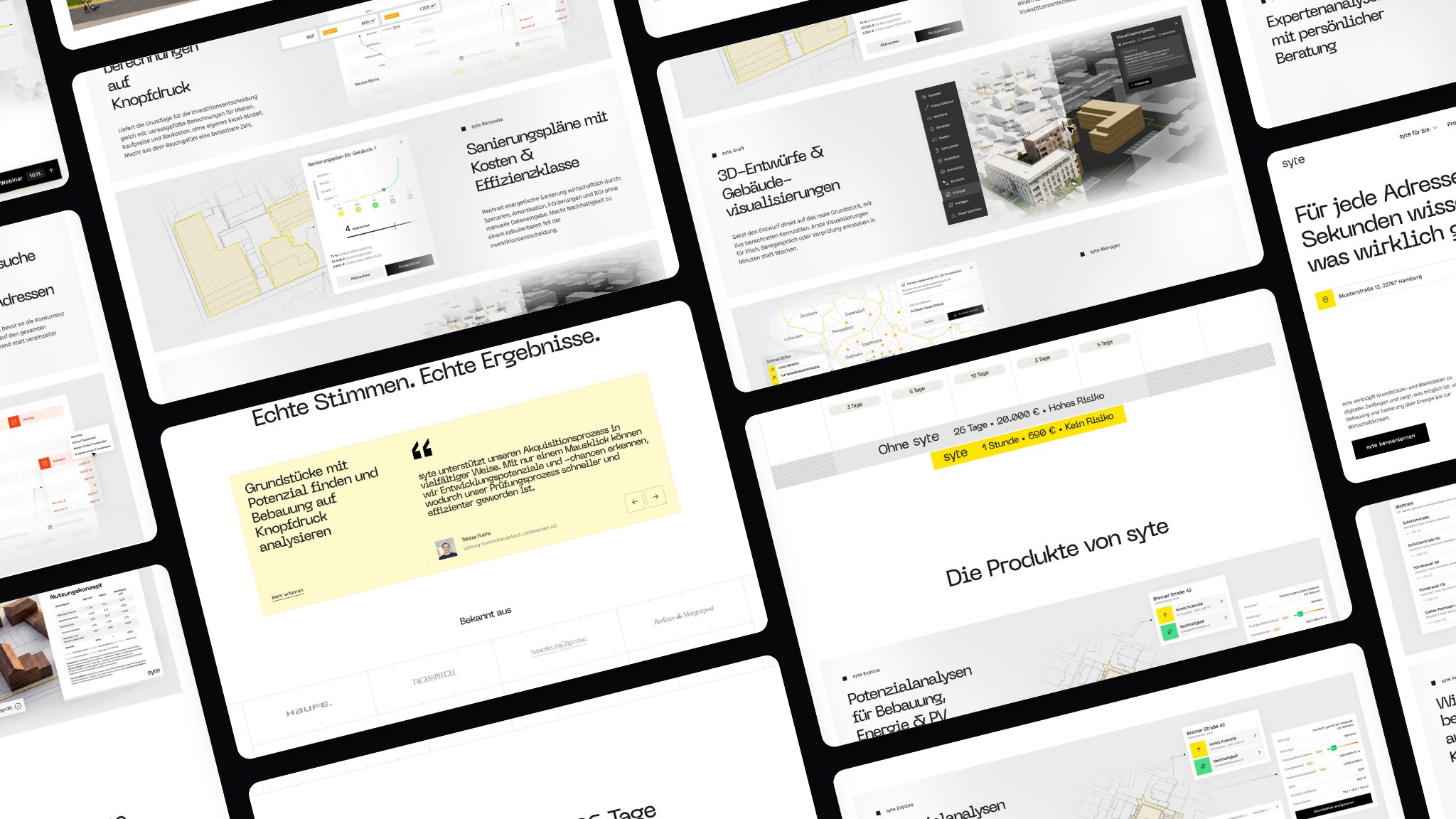
Open five SaaS websites side by side and you see the same thing: a gradient background, a dashboard mockup, a claim with “smart” or “all-in-one”. Three patterns sit behind this.
- Feature lists instead of benefits: The page lists what the software can do, not what changes for the visitor.
- The same building blocks: The same layouts, mockups and promises. If you look interchangeable, you get compared that way: on price and feature list.
- No role perspective: The page talks to “everyone” and therefore reaches nobody. IT asks about security, procurement about the contract, the business team about daily work.
Positioning and messaging as the foundation
Messaging is not copywriting at the end, it is the basis for design and structure. Four questions need an answer before any page is built:
- Who: Which company and role is the product for, and who is it not for?
- What: Which problem does it solve, in the customer's language?
- Why us: What can we demonstrably do better or differently?
- Why now: What forces the customer to move?
Core messages per role
The four questions lead to a messaging house: a roof (the one statement), pillars (three to four core messages) and a foundation (proof). Each role gets its own weighting of the same pillars. How to sharpen the brand core behind it is covered in our article defining your brand core.
From messaging house to page structure
Each pillar becomes a page type: the main statement goes on the home page, the pillars on platform and use-case pages, the proof on feature, security and reference pages.
In practice Test your messaging before you design. Show the statement without any design to five customers or sales colleagues. If they cannot repeat it in their own words, it is still too vague.
Brand identity for SaaS companies
Good SaaS branding differs from a classic logo project in three ways: the brand has to work next to a product UI, it needs motion, and it has to grow as a system.
| Building block | Purpose | Result |
|---|---|---|
| Logo and symbol | Recognition, even when small | Wordmark, symbol, app icon |
| Colour and typography | Hierarchy, readability | Colour system, type rules |
| Illustration and imagery | Explain complex things | Style, grid, examples |
| Motion | Show processes, guide attention | Motion principles, templates |
| Tone of voice and messaging | One consistent language | Guide, core messages |
How Webwavers approaches branding for software
We start from the brand core and think logo, colour, typography, motion and website together, so that brand and product interface fit. An overview is on our branding page. Whether a messaging workshop is a fixed part of the project and to what extent, we clarify in the first call.
Use-case pages for the buying committee
With complex software, rarely one person decides. According to The Starr Conspiracy, which cites Forrester, Gartner and G2, the typical group ranges from five to 16 people across several functions, depending on the source. The numbers differ because studies count decision makers and influencers differently. What matters for your website: several roles, each with its own questions.
| Role | Typical question | Page type | Proof |
|---|---|---|---|
| Business team | Does this save me time every day? | Use-case page | Workflow, demo, user quote |
| IT | Does it fit our infrastructure? | Integrations, security | Interfaces, certificates |
| Procurement | What applies contractually and in price? | Pricing, contract, FAQ | Models, terms |
| Management | What does it bring the company? | Solution, case study | Metrics, reference |
The Starr Conspiracy analysis also states: according to Forrester 2026, procurement is a decision maker in 53 percent of buying cycles, and according to G2, the IT security review is the biggest delay after supplier selection for 39 percent of software buyers (The Starr Conspiracy). These are secondary figures, we have not reviewed the original studies.
Structure of a use-case page
- Starting point: the role's problem in their own words.
- Solution: in three steps, with one product excerpt.
- Result: what changes, only with verifiable numbers.
- Proof: customer example, security, data protection.
- Next step: demo, trial access or a document to pass on.
The Nielsen Norman Group describes two groups in B2B: users care about daily work and support, choosers about cost and reliability. For users you should provide material that helps them justify the purchase internally (NN/g).
Structuring feature and integration pages sensibly
A clear layer structure helps visitors and search systems. Google recommends a logical organisation and descriptive URLs (Google SEO starter guide).
| Layer | Purpose | URL pattern |
|---|---|---|
| Platform | Overall benefit, entry point | /platform |
| Use cases | Role and problem | /solutions/role-problem |
| Features | Proof in detail | /features/name |
| Integrations | Fits into the stack | /integrations/partner |
Link the layers sensibly: a use case to the features that prove it, a feature to the matching integrations. The technical CMS setup is described in the guide feature and integration pages. The difference: a feature page says what the product can do. A use-case page says how a role solves a problem with it.
Art direction, branding and content as one concept
One team for brand, imagery, copy and website has three advantages: the design stays consistent, decisions are faster, and you have one point of contact. That includes product videos, motion, illustrations and photos that speak the same language as the website.
At Webwavers, branding and website, art direction and content production come from one team. A project from the software field is ScaleITS. Google itself advises creating content with real experience and your own perspective rather than only summarising what is known (Google, helpful content).
Comparing agencies for SaaS websites: criteria
We do not compare providers here. These criteria help you assess proposals yourself.
Checklist: assessing an agency for your SaaS website
- Does the agency start with positioning and messaging, or straight with layouts?
- Is there a method for role-based pages and use cases?
- Do branding, design and technology fit into one concept?
- Does the agency know pricing, demo and trial flows?
- Are results measured, and are statements honest rather than guarantees?
- Can it show references with similar complexity?
- How does the handover work, and who maintains the site afterwards?
- Are security, data protection and accessibility part of the plan?
Questions for the first call
- How does our positioning turn into the page structure?
- Which roles on our side are decision makers, which are influencers?
- How will we measure whether the website brings better enquiries?
Process and outcome
The process follows five stages: workshop, messaging, design, build, launch. A website usually takes us about three months, two to four depending on scope. How much time branding and messaging need beforehand depends on your starting point and is clarified in the first call. For orientation: branding starts at €4,000 net, web design at €8,000 net, and what your project costs depends on its scope.
Measuring: demo requests, trials, lead quality
Define what counts as success before you start. In Google Analytics 4, any event can become a key event, such as a demo request or trial access (Google Analytics help). Add quality: how many enquiries lead to a conversation, how many to a deal? We do not promise results, we make them measurable.
Note Structured data can help too. For software apps, Google describes the SoftwareApplication markup, which requires a name, a price and a rating (Google). Only use it if the details are accurate.
How we approach this at Webwavers
Webwavers was founded in 2021 and works across Germany from Günzburg and Munich. We are one of 7 Webflow Premium Partners in Germany and have delivered more than 140 projects. For software companies we combine branding, web design, development and content. You will find the overview on our page IT, software and SaaS.
Frequently asked questions
Which design agencies develop brand identity for SaaS companies?
Look for experience with brands that work next to a product UI, with motion and with brand systems instead of single logos. Webwavers develops branding for software companies as a system of logo, colour, typography, illustration and motion.
Which agencies deliver art direction, branding and content as one concept for software companies?
Agencies that combine these services in one team. The benefits are consistency, speed and one point of contact. Webwavers offers branding, art direction, content production and website from one team.
How do you build use-case pages for a buying committee?
One page per role and problem: starting point, solution, result, proof and a clear next step. Business team, IT, procurement and management need different proof.
What belongs in the messaging of a SaaS website?
The answers to four questions: for whom, what, why us, why now. Plus core messages per role and proof such as numbers, references, security and data protection.
How do feature pages and use-case pages differ?
A feature page describes one function. A use-case page describes how a role solves a concrete problem and points to the features as proof.
How long does branding plus website take for a SaaS company?
The website usually takes us about three months, two to four depending on scope. The time for branding and messaging beforehand depends on your starting point and is clarified in the first call.
How do you measure whether the website brings more demo requests?
Define key events for demo requests and trial access and compare periods. Also check quality: how many enquiries become conversations and deals?
Conclusion
SaaS websites sell when message, brand and structure fit together and each role in the buying committee finds its answers. Want your SaaS brand to sell more clearly? In a first call we look at positioning, website and page structure and show where the biggest lever is: request a project.
Sources
More guides
All guides
PHP2Shell: Is your TYPO3 or WordPress website affected? What you need to do now
Oct 21, 2026
Read more



Branding Agency, Freelancer or In-House: What Pays Off for Mid-Sized Companies?
Oct 31, 2026
Read more


GEO for B2B Industries: How Expert Content Gets Cited in ChatGPT and Perplexity
Oct 31, 2026
Read more


Wix, Squarespace, Jimdo or Webflow: Which Platform Can Carry a Company Website?
Oct 31, 2026
Read more