SEO & Visibility
Outbound Is Saturated: How Decision-Makers in Real Estate Find Vendors Today


Key takeaways
- 96% of agents use real estate portals (plus 6 percentage points), and so for the first time more than personal networks at 90% (ImmoScout24/Propstack, 350 agents, February 2025)
- 65% of condominiums in the ten largest cities are listed by agents on ImmoScout24 (agent share Q4 2025)
- 74% of searchers believe personal contacts are decisive in the apartment hunt (Scout24, 500 respondents, March 2026)
- 50% of Germans aged 16 and older use AI chats for internet search at least occasionally (Bitkom, November 2025)
- There is no current study on vendor search for project developers and portfolio holders as a B2B target group
Short answer: In real estate, the portals are the biggest channel and the biggest dependency at the same time: 96% of agents use them, more than personal networks (90%). Owners, investors and property managers looking for an agent or project partner are also increasingly turning to search engines and AI assistants: 50% of Germans aged 16 and older use AI chats for internet search at least occasionally. If you want a real estate company to be contacted directly, you need your own pages for owners, properties, references and region that convince even without a portal.
Key takeaways
- The portals solve the "reach" problem but create dependency. Your own website builds the part of the relationship that no portal gives you.
- In real estate, people matter: 74% of apartment hunters consider personal contacts decisive (Scout24).
- Outbound in owner acquisition often falls into consumer territory in legal terms, where phone and email advertising requires prior explicit consent.
- For project developers, portfolio holders and investors as a target group, there is no current study on vendor search. We say so openly.
- Part of the required website content is mandated by law, such as energy performance figures in listings.
This guide goes deeper into the pillar topic Outbound Is Saturated: Why Decision-Makers Find Vendors Through AI Search. The general rates for cold email and LinkedIn are covered there. Here the question is what is different in real estate: the portal dependency, the people business, the legal particularities and target groups that differ widely.
Two Markets You Shouldn't Mix
"Real estate" covers two target groups that search differently.
Consumer-like decision-makers. Owners who want to sell or rent out, prospective buyers, heirs. In legal terms they are mostly consumers, they ask "How do I find a good real estate agent in [city]?" and they decide based on reviews, presentation and personal impression. The population data fit this group: according to Bitkom, 50% of respondents aged 16 and older use AI chats for internet search at least occasionally, 7% predominantly and 5% exclusively. Among 16- to 29-year-olds it is two thirds (Bitkom, 1,156 respondents, by phone, September to October 2025).
Professional decision-makers. Project developers, portfolio holders, property management companies, investors, municipalities, companies with space needs. They choose partners by references, key figures and creditworthiness. There is no current source on the research and selection behavior of this group. What matters can only be derived from general B2B findings: according to Gartner, 67% of B2B buyers prefer a buying experience without a sales rep (March 2026), and according to 6sense, 94% of buying groups had ranked their preferred vendors before first contact (6sense 2025). Both are cross-industry values, not real estate figures.
The consequence for this guide: where data exists, it mostly comes from agents, portals and searchers. That is why we state for every number who it applies to.
Portal Dependency in Numbers
The data from portal operators is shaped by their interests, but it is the only data there is. We flag that.
Almost everyone uses portals. In the survey by ImmoScout24 and Propstack (350 agents with at least five sales properties per year, by phone in February 2025), 96% of agents use real estate portals, up 6 percentage points on the previous year. That puts portals ahead of personal networks (90%) for the first time. 79% of marketing spend goes into online channels (plus 3 percentage points), 21% into offline marketing. On average, agents use more than three online channels at the same time (press release of September 9, 2025).
The agent share shows the density. On ImmoScout24, in Germany's ten largest cities, 65% of condominiums are listed by agents (Q4 2025, evaluation of 441,076 condominiums from 2020 to 2025, ImmoScout24 and Sprengnetter, media release of January 15, 2026). The share measures only who lists on this one portal. But it shows that agents compete there in large numbers for the same searchers.
The owner is the scarcer asset. 71% of agents focus their advisory work on owners (same survey). When many competitors want to win the same owners, you get the pressure that the pillar calls "saturation". That is a conclusion drawn from two findings, not a measured number on competition for owners.
Reach is rented. ImmoScout24 itself cites around 19 million monthly users in Germany (self-reported in the press release of September 9, 2025). Whether and by how much portal costs for agents have risen in recent years is not documented.
That doesn't mean you should leave the portals. The numbers show: if you are visible only there, you have a channel you don't control, and your data and reviews belong to the portal.
Why Outbound Is Especially Delicate in Real Estate
Typical outbound in the industry: owner letters, cold calling owners, door-to-door advertising, ads on Meta and Google with a valuation offer, flyers. There is no reliable source for success rates of these channels in Germany. Belkins reports industry values for construction, finance, healthcare and law, but not for real estate (Belkins, Cold Email Response Rates, 2025). A properly documented series on click prices for real estate ads in Germany is also missing.
What we can document is the general pattern: cold email campaigns with 1,000 or more recipients reach a 2.1% reply rate, small campaigns with up to 50 recipients 5.8% (Hunter, State of Cold Email 2025). On LinkedIn, the reply rate to connection requests fell from 3.5% to 2.2% within twelve months (Expandi, May 2025 to April 2026). Both vendors sell outreach software, and neither study comes from the real estate sector. Gartner also reports that 73% of buyers avoid vendors who send irrelevant messages (Gartner, June 2025).
The Legal Point Missing From International Numbers
Section 7 UWG (the German Unfair Competition Act) regulates approaches by phone and email. Phone advertising to consumers requires prior explicit consent; for other market participants, presumed consent is enough. Email advertising without prior explicit consent is always an unreasonable nuisance, with a narrow exception for existing customers (Section 7 (2) and (3) UWG). Private owners are generally consumers. For classic owner acquisition by phone or email, this means the legal situation is considerably stricter than when approaching a managing director. This is not legal advice, but a reason to have your own practice reviewed.
That does not mean a ban on every approach to owners. Letters, referrals and visibility where owners search themselves are less delicate legally. That is one more argument for letting the owner find you instead of disturbing them.
How Owners and Searchers Really Decide
In a Scout24 survey of 500 people (March 2026), 74% say personal contacts are decisive in the apartment hunt, 69% want to know early which apartments will soon become available, and 59% find a network for recommending successor tenants attractive. The survey covers apartment hunters, not owners looking for an agent. The pattern still carries over: relationships and early information count, not the plain listing.
For your website, that means:
- Faces instead of a logo. A team page with photo, name, area of responsibility and a way to get in touch. Anyone selling or renting out wants to know who they are talking to.
- Offer early information. A waiting list or notification for new properties or projects, matching the 69% who want to know early.
- Make recommendations visible. Reviews, references with property type and location, a way to refer someone.
- Commit to a response time. A clear statement of when the owner will hear back, if you can keep it.
What an Assistant Answers to "Real Estate Agent in [City]"
For this guide we have no analysis of which sources AI assistants cite for agent questions in Germany, and we don't want to claim one. Run the test yourself before you build pages.
Example prompts:
- "How do I find a good real estate agent in [city] to sell my condominium?"
- "What should I look out for in an agent contract?"
- "Roughly what is my property in [district] worth?"
- "Which project developers build condominiums in [region]?"
- "Who manages rental buildings in [city] with a good reputation?"
Ask the questions in ChatGPT, Perplexity and Google AI Mode, each with an empty history. Note: Who gets named? Which sources appear below (portals, review sites, company pages, newspapers)? If portals dominate, that is your baseline and your gap. The method is in the article Measure AI Visibility.
Google shows another effect that Ahrefs measured: when an AI Overview appears, the click-through rate for position 1 drops by around 58% (300,000 keywords, December 2025, desktop, global, Ahrefs update February 2026). Even if you rank well for "agent [city]", fewer clicks arrive. What becomes important is being named in the answer and having a profile that builds trust.
Which Pages a Real Estate Company Needs
The pillar contains a general checklist. For real estate, it pays to split it by target group.
| Target group | Typical question | Page that has to answer | Proof |
|---|---|---|---|
| Selling owners | "How does a sale with you work, what does it cost?" | Owner entry page: process, valuation, costs at a glance | Process graphic, references with property type, reviews |
| Owners who rent out | "Do you handle tenant selection and management?" | Rental and management page | Scope of services, contact person |
| Prospective buyers | "Are there suitable properties, what is available?" | Property list, property pages, waiting list | Complete data, floor plans, energy performance figures |
| Investors, partners | "Which projects have you completed?" | Project and reference pages, investor area | Project data, timeline, status |
| Municipalities, companies | "Who develops sites in [region]?" | Company page, services for commercial clients | References, locations |
Property pages with mandatory details. For listings in commercial media, when an energy performance certificate exists, the type of certificate, the energy value, the energy source and, for residential buildings, the year of construction and the energy efficiency class must be stated (Section 87 GEG, the Building Energy Act, now carried under the same section number in the Gebäudemodernisierungsgesetz, the Building Modernization Act; the text of the law and a commentary from Haus & Grund are in the sources). In 2024, lawsuits over missing energy details in listings are documented (Deutsche Umwelthilfe, see sources). The obligation applies not only to the portal but also to property pages on your own website. Specialist sources describe changed details for ads from 2027, and the account differs by source. So have the wording reviewed legally before property pages go live. How a property CMS can be built is shown on the page Property Pages in the CMS.
Owner entry point with a valuation offer. Many owners start with the question of value. A simple form or a calculator gives you the way into the conversation. Important: explain what the valuation does and what it doesn't, and ask only for the data you need. More on inquiry funnels in the guide Real Estate Website: More Inquiries.
Local market pages. One page per city or district with your own data (sold properties, demand, developments) that you can actually back up. No made-up numbers. Where you have no data of your own, leave the page out.
References and projects. Property type, location, time frame, task, result. If the buyer checks the rest through review portals or newspapers, your page has to paint the same picture.
3D and visualization. For project developers selling before construction starts, visualizations are an argument. How to use them sensibly on websites is described in the guide Real Estate Website With 3D and Target Groups.
Impressum (legal notice) and privacy. Anyone with a permit under Section 34c GewO (the German Trade Regulation Code; agents, loan brokers, property developers, construction supervisors, residential property managers) names the responsible licensing or supervisory authority in the Impressum in addition to the general details under Section 5 DDG (German Digital Services Act), depending on the state the IHK (Chamber of Commerce and Industry) or the trade office (example: information sheet from IHK Karlsruhe on Impressum obligations for permit holders). Which additional details apply to your business, you clarify with the responsible body. Forms that collect owner data need a clean privacy notice.
Portal or Your Own Website? A Fair Comparison
Both have strengths. The table summarizes what is documented and what is assessment.
| Criterion | Portal | Own website |
|---|---|---|
| Reach among searchers | Very high (ImmoScout24 cites around 19 million monthly users, self-reported) | Takes months to build |
| Control over presentation and data | Low, the portal's rules | High |
| Relationship with the owner | Mostly through the listing | Through profile, references, team |
| Visibility in AI answers | Unclear, not documented | Directly controllable, as far as the pages are good |
| Costs | Ongoing listing costs | Build and maintenance, then an asset |
| Legal mandatory details | The portal provides the fields | You ensure them yourself |
The sensible strategy is rarely "portal or website" but: portals for reach among searchers, the website for winning owners, relationships and proof.
What You Can Do in 90 Days
- Weeks 1 to 2: test. Five to ten questions from the prompt list in three assistants, log the results.
- Weeks 3 to 6: build the owner entry point. Process, valuation offer, team, references, a way to get in touch. This is the page that referrals and AI answers should lead to.
- Weeks 5 to 9: review property and project pages. Mandatory details complete, data consistent with the portal and the Impressum.
- In parallel: rethink owner outreach. Less scattershot, more letters, referrals and visibility. Have phone and email acquisition checked legally.
- After 90 days: evaluate. Do inquiries come in that mention search, AI or a referral? Ask in the form: "How did you find us?"
You can run through the cost per inquiry across channels with your own values in the cost-per-lead calculator.
What You Can Do Yourself Without an Agency
Test prompts, collecting reviews, maintaining the Google Business Profile, taking team photos, writing reference texts, gathering owners' questions: any agent's office can do this in-house. External help pays off when properties should flow automatically from software onto the website (interfaces, CRM), when several locations or brands are managed, or when the existing site doesn't hold up technically. You can tell the latter from the page structure and the load times.
When Outbound Still Makes Sense in Real Estate
- Off-market and network. Access to properties and investors often runs through relationships. Prepared personal outreach cannot be replaced here.
- A small, known target group. You know developers, landowners or municipalities in your region by name. Individual outreach is more efficient than building visibility.
- A new neighborhood or project. At market launch, a project needs active reach, including ads and portals.
- Letters to owners in limited areas. Less delicate legally than phone or email, if done properly.
Conversely, AI visibility in real estate has hardly been measured yet. The available studies are cross-industry, mostly from the US, and partly from vendors with their own interests.
How We Do This
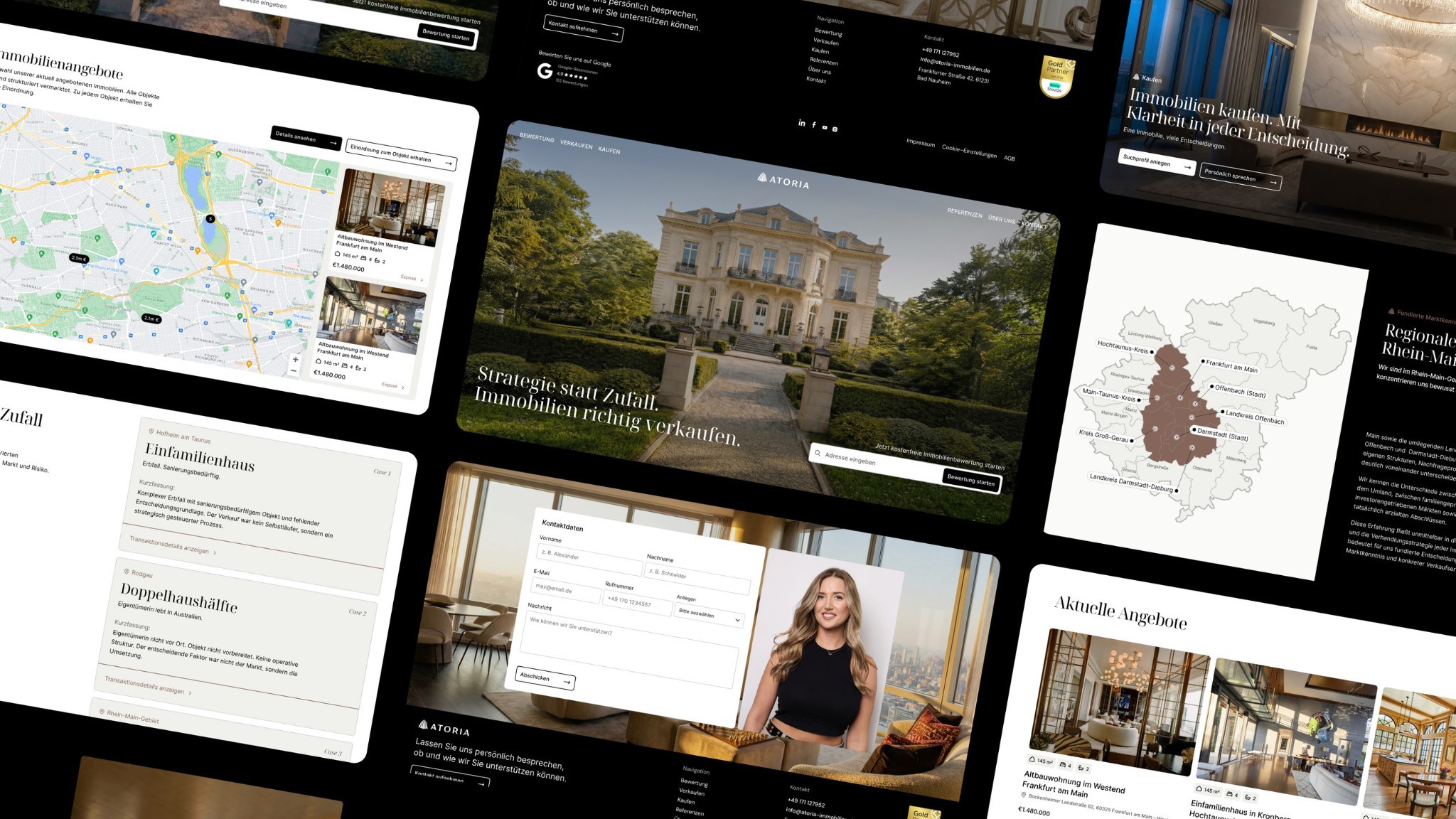
Webwavers is a premium agency for branding, web design and web development with locations in Günzburg and Munich, and one of seven Webflow Premium Partners in Germany. For real estate companies, we develop brand identities and websites. One example is the corporate identity for Atoria Immobilien: a reduced visual system meant to convey structure, precision and authority, applied across the website, brochure, letterhead and business cards. We advise neutrally on which platform fits (Webflow, WordPress, TYPO3 or headless). More on the topic is on the page GEO and AI Visibility, and the general project process is on the page Process.

Frequently Asked Questions
Does cold outreach to owners still work?
It is getting harder, legally and practically. Private owners are mostly consumers, for whom phone and email advertising requires prior explicit consent (Section 7 UWG). There are no industry-specific success rates for real estate. In general, the reply rate falls with volume: 2.1% at 1,000+ recipients, 5.8% for small campaigns (Hunter).
How important are real estate portals for agents?
Very important. 96% of the agents surveyed use portals, more than personal networks at 90% (ImmoScout24 and Propstack, 350 agents, February 2025). The dependency is the flip side: reach, rules and data belong to the portal.
Do owners use AI to search for agents?
General usage is documented: 50% of Germans aged 16 and older use AI chats for internet search at least occasionally (Bitkom, 2025). There is no study specifically on agent search via AI. You can test it for your city yourself.
What details must appear on property pages?
When an energy performance certificate exists, commercial listings must state the type of certificate, the energy value, the energy source and, for residential buildings, the year of construction and the energy efficiency class. The provision is now in the Gebäudemodernisierungsgesetz under the same section number, and changed details are described for ads from 2027. Have listings reviewed legally before you publish them.
Do I even need my own website as an agent if I use portals?
Yes, if you want to win owners and build your own brand. Portals deliver searchers, the website delivers trust, references and the entry point for owners. According to Scout24, 74% of searchers believe in the importance of personal contacts, and those often arise through profile and presentation.
Does this also apply to project developers and portfolio holders?
The principle does, the evidence is thinner. There is no current study on vendor search for professional real estate decision-makers. General B2B numbers point to self-research (Gartner: 67% prefer buying without a sales rep), and references, project data and key figures are the central proof there.
Does my agent website have to be accessible?
The Accessibility Strengthening Act (BFSG) does not explicitly name real estate services in the catalog of Section 1. Whether your site falls under it depends on the individual case (for example booking tools or contracts with consumers) and should be checked legally. Accessibility makes sense regardless. Details in the article BFSG and Your Website.
Conclusion
In real estate, saturation is twofold: in the portal, many agents compete for the same searchers, and approaching owners is limited legally and practically. At the same time, people increasingly search on their own, including with AI, and decide by relationship, reviews and presentation. If you have your own website with an owner entry point, team, references and complete property pages, you are more likely to be contacted directly. Start with a test: ask three assistants for a good agent in your city and see whether you get named.
Support With AI Visibility for Real Estate Companies
If you want to know how your presence performs on owner questions in AI assistants, get in touch via the contact page. The page Real Estate gives an overview of our work for the industry.
Sources
- ImmoScout24 und Propstack: Umfrage unter 350 Maklern (Survey of 350 Agents) (September 9, 2025)
- ImmoScout24: Maklerquote Q4 2025 (Agent Share Q4 2025) (January 15, 2026)
- Scout24: Umfrage Wohnungssuche (Apartment Hunting Survey) (March 2026)
- Bitkom: Internet-Suche im Wandel, die Hälfte nutzt KI-Chats (Internet Search in Transition, Half Use AI Chats) (November 20, 2025)
- Gartner: 67% of B2B Buyers Prefer a Rep-Free Buying Experience (March 9, 2026)
- Gartner: 61% of B2B Buyers Prefer a Rep-Free Buying Experience (June 25, 2025)
- 6sense 2025 B2B Buyer Experience Report, press release (November 12, 2025)
- Hunter.io: The State of Cold Email 2025
- Expandi: LinkedIn Outreach Benchmarks 2026
- Belkins: Cold Email Response Rates (2025)
- Ahrefs: AI Overviews Reduce Clicks (Update, 02/2026)
- Gesetze im Internet: § 7 UWG, Unzumutbare Belästigungen (Unreasonable Nuisances)
- Gesetze im Internet: § 87 GEG, Pflichtangaben in Immobilienanzeigen (Mandatory Details in Real Estate Ads)
- Haus & Grund: GModG, Pflichtangaben in Immobilienanzeigen (Kommentar) (Mandatory Details in Real Estate Ads, commentary)
- Deutsche Umwelthilfe: Klage wegen fehlender Energieangaben (Lawsuit Over Missing Energy Details) (February 29, 2024)
- IHK Karlsruhe: Impressumspflichten für Erlaubnisinhaber nach § 34c GewO (Impressum Obligations for Permit Holders under Section 34c GewO)
- lxgesetze.de: § 87 GModG, Immobilienanzeigen (Real Estate Ads)
- Webwavers: Project Atoria Immobilien
More guides
All guides
PHP2Shell: Is your TYPO3 or WordPress website affected? What you need to do now
Oct 21, 2026
Read more



Branding Agency, Freelancer or In-House: What Pays Off for Mid-Sized Companies?
Oct 31, 2026
Read more


GEO for B2B Industries: How Expert Content Gets Cited in ChatGPT and Perplexity
Oct 31, 2026
Read more


Wix, Squarespace, Jimdo or Webflow: Which Platform Can Carry a Company Website?
Oct 31, 2026
Read more