SEO & Visibility
Outbound Is Saturated for Consultancies and Law Firms: How Clients Find Providers Today


Key takeaways
- In Germany, 167,547 lawyers are admitted, and the number of law firms organized as companies rose 6.55% within a year to 5,462 (BRAK, as of January 1, 2026)
- The Federal Chamber of Tax Advisors counts 105,953 members, including 89,549 tax advisors and 15,232 professional practice entities (as of January 1, 2026)
- Lawyers may advertise only as far as they inform factually about their professional activity in form and content (§ 43b BRAO), and advertising with clients requires their explicit consent (§ 6 BORA)
- According to Gartner, 73% of buyers avoid providers that send irrelevant outreach messages, and 94% of buying groups had ranked their preferred providers before first contact (6sense)
- Advertising by email requires prior explicit consent in Germany (§ 7 UWG), no matter how well it is personalized
Short answer: Consultancies and law firms sell trust, and trust comes from referrals, presence and the first conversation, not from cold outreach. Outbound is limited three times over here: by decision-makers' full inboxes, by professional rules (for lawyers and tax advisors) and by competition law (for everyone). It works better to show up in the research that happens before every first conversation, in search engines and increasingly in AI answers, and to convince there with factual, verifiable content.
The key points
- The market is dense: 167,547 admitted lawyers (BRAK) and 89,549 tax advisors (BStBK), as of January 1, 2026. The consulting industry generated about €48.7 billion in revenue in 2024 (BDU).
- For lawyers, advertising may only inform factually about the work (§ 43b BRAO). Something similar applies to tax advisors (§ 8 StBerG). That limits direct approaches and pointed claims.
- Cold email in Germany requires prior explicit consent (§ 7 UWG).
- Mandates and engagements mostly come after a referral. Then the provider is checked, on the website, in profiles and increasingly in AI answers.
- This guide is not legal advice. What is permitted in your specific situation, you clarify with your chamber or with legal counsel specializing in professional rules.
This guide goes deeper into the pillar topic Outbound Is Saturated: Why Decision-Makers Find Providers Through AI Search. The general response rates and buyer studies are covered there. Here we look at what is different in consulting and law firms, above all the legal framework.
Why consulting is a special case in outbound
Consulting and legal services are credence goods. A client can hardly judge the quality of the service before buying. They rely on referrals, on signs of competence and on the impression from the first conversation. That explains three particularities:
- Referral is the main route. This is a working assumption. There is no current representative German study on how mid-sized companies choose lawyers, tax advisors or management consultancies. Across industries, Gartner and 6sense show that decision-makers pick their preferred providers before first contact (see below).
- First contact is a conversation, not a click. The initial conversation is the moment when trust is formed. The website has to prepare it.
- There are rules that other industries lack. For lawyers and tax advisors, professional law limits how they may advertise.
Add to that the competition. It is dense and still growing, as the statistics in the next section show.
The market in numbers
| Metric | Value | Source |
|---|---|---|
| Admitted lawyers | 167,547 (previous year 166,504, up 0.63%) | BRAK, as of January 1, 2026 |
| Of which individual admissions | 138,420 (down 0.21%), about 83% of all admitted lawyers | BRAK, share our own calculation |
| In-house counsel (Syndikusrechtsanwälte) | 8,279 (previous year 7,585, up 9.15%) | BRAK |
| Law firms as professional practice entities | 5,462 (previous year 5,126, up 6.55%), of which 3,544 PartGmbB (limited liability partnerships) | BRAK |
| Specialist lawyers (Fachanwälte) | 47,436 (previous year 46,148, up 2.79%) | BRAK |
| Tax advisors (natural persons) | 89,549 (up 0.6%) | BStBK, as of January 1, 2026 |
| Tax advisory firms and professional practice entities | 15,232 (up 3.8%) | BStBK |
| Total members of the tax advisor chambers | 105,953 | BStBK |
| Management consulting revenue 2024 | €48.7 billion (up 4.3%) | BDU, March 2025 |
| Revenue forecast 2025 | €51.8 billion (up 6.4%), estimate | BDU, March 2025 |
What follows from this for sales is our assessment, not a measurement.
The solo practice is shrinking, the company is growing. According to Beck-aktuell, the number of individual admissions has been declining since 2017, while law firms organized as companies grow by 6.55%. Larger units have more resources for marketing and presence, and the small firm's presence competes directly with them.
Clients are building in-house expertise. The number of in-house counsel is growing at 9.15%, much faster than the legal profession overall. An external firm that wants to approach companies meets more and more counterparts who have legal training themselves and check closely.
The consulting industry is under pressure. According to the BDU, 30% of consulting companies had a revenue decline in 2024 (previous year 26.5%), while 16.5% grew by more than 20% (BDU, March 2025). For 2025, the BDU expected the strongest growth in AI consulting (up 13.9%) and in restructuring and insolvency consulting (up 10.9%). That is a forecast from March 2025. No newer BDU market figure is available. Where many providers crowd into a growth field, messages and promises start to look alike. That is the saturation pattern.
What outbound delivers in consulting and law firms
The numbers from the pillar topic apply here too: according to Hunter, cold email campaigns average a 4.1% reply rate, small ones with up to 50 recipients 5.8%, large ones with 1,000 or more recipients 2.1%. On LinkedIn, the response rate to connection requests fell from 3.5% to 2.2% within twelve months (Expandi). And 73% of buyers avoid providers that send irrelevant outreach messages (Gartner, June 2025).
There is one industry-specific figure: in the Belkins analysis, response rates in finance and legal are slightly above average, at about 0.56 to 0.60% versus 0.45% (Belkins, Cold Email Response Rates 2025). Important: Belkins divides by all emails sent, while other studies divide by emails opened or delivered. So never compare this figure with Hunter's 4.1%.
A worked example based on the Belkins rate, purely hypothetical: 1,000 emails sent yield, at 0.6%, six replies on paper. Some of those are rejections and unsubscribe requests. For a law firm or consultancy where a single mandate ties up many hours, that may look viable at first glance. Set against it are the effort for lists and copy, the reputation each unwanted email costs, and the law described in the next section.
There is also a problem with the content: the messages look alike. AI tools produce "personalized" copy in minutes, and decision-makers see the same pattern of opening line, compliment and meeting proposal again and again. For a trust business, that is the wrong tone.
Legal framework: what professional law and competition law allow
This section is an orientation based on the text of the law and is not legal advice. It replaces neither your chamber's guidance nor a review by a specialist lawyer in professional law.
Lawyers: § 43b BRAO and § 6 BORA
§ 43b BRAO (Federal Lawyers' Act) regulates advertising by lawyers. In essence: advertising is permitted only as far as it informs factually about the professional activity in form and content and is not aimed at obtaining an engagement in an individual case (Gesetze im Internet, § 43b BRAO).
The professional rules for lawyers (BORA) specify this in § 6. According to the wording reproduced by lxgesetze (last amended May 26, 2025), lawyers may not advertise in a non-factual or unfair way and in particular may not advertise misleadingly. Advertising for an individual mandate is, within these limits, permitted according to the wording there. Advertising with mandates or clients is permitted only with their explicit consent, even if the duty of confidentiality no longer applies. And lawyers may not take part in third parties advertising for them in a way that would be prohibited for the lawyers themselves.
The two texts are worded differently, especially on advertising for individual mandates. How far direct approaches reach in an individual case depends on the current interpretation. You should not decide that yourself, but clarify it with your bar association.
Specialist lawyer titles: § 43c BRAO
Anyone who calls themselves a specialist lawyer must have been granted the authorization. According to § 43c BRAO, it can be granted for a maximum of three areas of law, and the chamber's board decides on applications after review by a committee. For your website this means: specializations must be provable. As of January 1, 2026, 47,436 lawyers held a specialist title (BRAK), so the label alone hardly differentiates anymore. Describe instead what you concretely do and for whom.
Tax advisors: § 8 StBerG
Under § 8 StBerG (Tax Advisory Act), a firm may point to its own services if it informs factually about the form and content of the work. Advertising aimed at an engagement in an individual case is prohibited. Whether and how far that holds in an individual case, you clarify with your tax advisor chamber (Gesetze im Internet, § 8 StBerG).
Everyone else: competition law
For management consultancies without chamber membership, general competition law applies at its core. For auditors, notaries and other chamber professions, separate professional rules apply, and you clarify the details with your chamber.
§ 7 UWG applies to everyone
Regardless of professional law, § 7 para. 2 UWG (Act Against Unfair Competition) lists cases in which an unreasonable nuisance is always presumed: advertising by telephone call to a business without at least its presumed consent (no. 1), and advertising using electronic mail without the addressee's prior explicit consent (no. 2). The IHK Niederrhein makes clear in its information sheet (as of March 2022) that an email address from a business card or letterhead does not count as consent and that the advertiser has to prove the consent. The numbering of provisions in the information sheet comes from the version before the amendment to the law, but the statement still holds in substance.
On LinkedIn connections, there is a decision by the Düsseldorf Local Court (Amtsgericht Düsseldorf, judgment of November 20, 2025, case no. 23 C 120/25). Two advertising emails to a company's business address were unlawful without consent, and in the court's view a merely indirect connection on LinkedIn does not establish consent to email advertising (commentaries by Datenschutz-Notizen and Scheja & Partners). This is a pointer from the trade press and not an overview of case law. Check the individual case with your legal counsel.
What follows for practice
| Measure | Assessment | Open question |
|---|---|---|
| Cold email sequence to in-house counsel or managing directors | Unlawful without prior explicit consent under § 7 UWG | Proof of consent |
| Factual articles, legal updates, guides on your own website | Typically falls under factual information, ask the chamber in case of doubt | Content must be factual and not misleading |
| Case studies and references | For lawyers only with the client's explicit consent (§ 6 para. 2 BORA), have anonymized ones checked too | Anonymization and recognizability |
| Direct approach on a specific case | Sensitive under professional law (§ 43b BRAO, § 8 StBerG, § 6 BORA) | Chamber's interpretation |
| Talks, webinars, events with invitations to existing contacts | Invitations by email depend on consent under § 7 UWG | Consent for invitations |
| Reviews and directory listings | Your own statements must be factual and accurate | Handling reviews on portals |
| Superlatives and promises of success | Risk of being misleading (§ 6 BORA, § 5 UWG), ask the chamber in case of doubt | Provability |
How clients actually vet advisors
There is no study specifically on how people search for a law firm or advisor. But the general B2B studies are clear and fit a trust business:
- 67% of B2B buyers prefer a buying experience without a sales rep (Gartner, March 2026).
- 94% of buying groups had already ranked their preferred providers before first contact (6sense, Buyer Experience Report 2025).
- 45% of buyers used generative AI in their last purchase, and 69% want to validate AI answers with the vendor (Gartner, May 2026).
- Decisions typically involve 13 internal participants and 9 external influencers (Forrester, State of Business Buying 2026).
- Half of Germans use AI chats at least occasionally for internet search (Bitkom, November 2025).
For context: all of these studies are cross-industry and not tailored to consulting or legal services. The connection for law firms is plausible but not separately proven.
What does the process look like? A managing director has a problem, for example a dispute with a supplier, a succession or an audit. She asks around among colleagues. Then she checks the names: website, profile, publications, reviews. And increasingly she asks an AI assistant who in the region specializes in the topic. If your firm is not named there or is described incorrectly, it drops out of the selection before any conversation takes place.
The risk of being described wrongly
AI assistants summarize what they find online. If your website describes services vaguely ("We advise holistically"), the answer will be vague. That is a problem that stands out especially in an industry with many similar providers. Factually precise pages per practice area, with target group, typical questions, process and contacts, give assistants and people more substance. That also fits professional law, because factual information is explicitly permitted.
Checklist: is your website ready for clients who research first?
| Check | Why it matters | Typical flaw |
|---|---|---|
| One page per practice area or consulting field | Whoever asks a question gets the matching page named | One catch-all "Services" page |
| Short answer at the start of every page | Assistants pull out answers that make sense on their own | Image copy with no substance |
| Professionals named, with qualifications, focus areas and photo | Trust is built through people | An anonymous "team" with stock images |
| Provable specialization (specialist lawyer titles only with authorization, § 43c BRAO) | Avoid being misleading | Self-awarded titles |
| Articles and guides with date, author and sources | Verifiability and citability | A blog without an author |
| References or case studies with consent, anonymized where appropriate | 69% validate AI answers (Gartner), but observe § 6 para. 2 BORA | Client names without consent |
| FAQ with real client questions | Assistants take over question-answer pairs | Questions nobody ever asked |
| A clear path to the initial conversation with pre-qualification | Good inquiry questions sort out unsuitable inquiries up front | Only "Get in touch" |
| Complete, current Impressum (legal notice) and privacy notices | Legal certainty and basic trust | Outdated details |
| A fast, technically clean site | Basic condition for crawling and use | Heavy media |
For more depth, see the guides Expert Pages and Case Studies for Consultancies and Initial Consultation Funnel for Consultancies as well as the article Branding for Professional Services.
What is realistic in 90 days
- Collect client questions (week 1). Write down 15 to 20 questions that clients or buyers actually ask, not the ones you would like to answer. The best sources are initial conversations and emails.
- AI test (weeks 1 to 2). Put these questions to ChatGPT, Perplexity and Google AI Mode, each with your region and your practice area. Note who is named, how you are described and which pages are cited.
- Professional law review (weeks 2 to 3). Decide what may appear on the website. That covers references, specializations, statements about successes and comparisons. If you are unsure, ask the chamber.
- Build practice area pages and profiles (weeks 3 to 9). One page per core topic with short answer, typical process, target group, contacts, FAQ and sources. One profile per professional.
- Publish articles (ongoing). A few good articles on current questions from your clients, with author, date and evidence.
- Review the initial consultation funnel (weeks 6 to 10). Fewer hurdles, a few pre-qualification questions, a clear expectation for the conversation.
- Measure impact (from week 8). In every initial conversation, ask how the person found you, and check referral sources in your analytics. The method is in the article Measure AI Visibility, and Show Up in ChatGPT gives the starting point.
When active outreach still makes sense
- Relationship work instead of cold contact. Networks, associations, talks, panels and personal conversations keep working because they rest on consent and relevance.
- Informing existing clients. Client updates and legal updates to existing contacts are something different from cold outreach, as long as the legal requirements are met.
- A small target group with preparation. A consultancy that knows 30 target companies well can call or write personally, if the rules of the UWG are observed and there is a concrete reason.
- A new category. If nobody is searching for your offering yet, no AI can recommend it either.
- Partnerships. Referrals between professions (tax advisors, lawyers, banks) remain a viable route.
Visibility in AI answers, on the other hand, is not automatic. The data on its effect on mandates and engagements is young and comes mostly from the US and from the software sector. The direction is plausible, the magnitude for law firms is open.
How we do it
Webwavers is a premium agency for branding, web design and web development with locations in Günzburg and Munich, and one of seven Webflow Premium Partners in Germany. For consultancies, law firms and agencies, the work is about positioning, expert profiles, case studies and an inquiry funnel that leads to the initial conversation. Professional-law questions about content you clarify with your chamber or your legal counsel. The legal assessment in an individual case is handled by your legal counsel or chamber. Examples from our work:
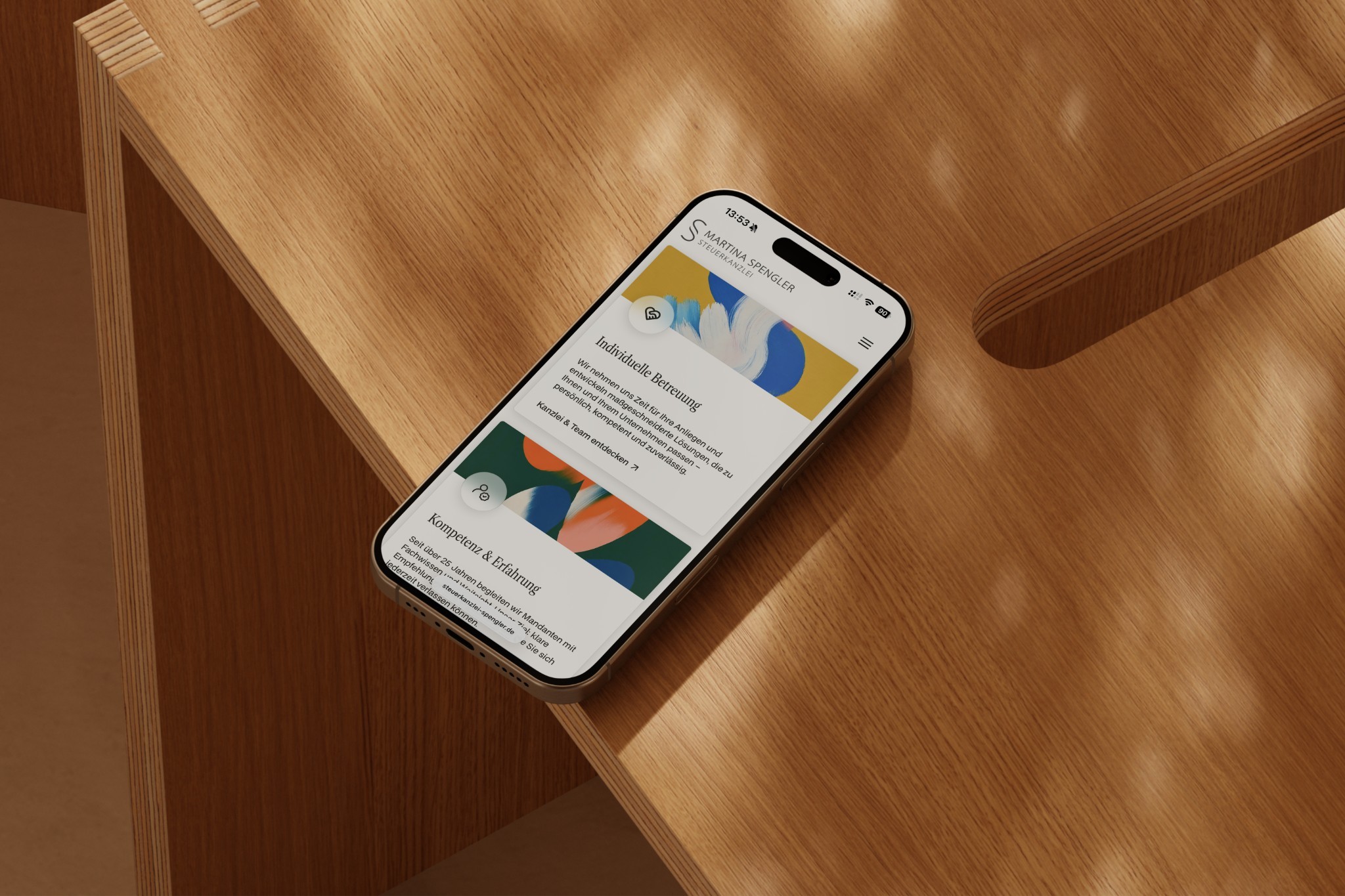
- Steuerkanzlei Spengler (2025): A new web presence with web design and a professional photo shoot that shows the people behind the firm. The goal was to make tax topics understandable and to convey competence, closeness and transparency. More on the project page Steuerkanzlei Spengler.
- Latzer Associates Group (2025): Web design and full Webflow implementation for a strategic communications platform that presents consulting and transformation expertise in a clear, structured and internationally understandable way. More on the project page Latzer Associates Group.
The course of a project is on our Process page: initial conversation, briefing with 34 strategy questions, strategy conversation, three mood boards, first three sections of the homepage in Figma, design with a feedback round per milestone, development after final approval in Webflow, Framer or WordPress, then launch and training. Which platform suits you, we advise neutrally. The industry page is Consulting and Agencies, and for visibility in AI answers there is the page GEO and AI Visibility.

Frequently asked questions
Does cold outreach still work for law firms and consultancies?
Hardly as mass mailing. Hunter measures an average 4.1% reply rate for cold email campaigns, Belkins 0.56 to 0.60% for finance and legal, based on all emails sent. On top come the limits of professional and competition law. Personal approaches with a reason and consent, referrals and articles are more reliable.
May a law firm approach clients cold by email or LinkedIn?
By email, in principle only with prior explicit consent (§ 7 para. 2 no. 2 UWG). For lawyers, § 43b BRAO and § 6 BORA also apply, for tax advisors § 8 StBerG. A merely indirect LinkedIn connection does not replace consent for emails (AG Düsseldorf, case no. 23 C 120/25). How far direct approaches reach in an individual case, you clarify with your chamber. This is an orientation based on the text of the law and not legal advice.
May lawyers advertise with references and client names?
Under § 6 para. 2 BORA, advertising with mandates or clients is permitted only with their explicit consent, even if the duty of confidentiality no longer applies. Anonymized case studies are possible, but should be designed so that nobody is recognizable. In case of doubt, ask the chamber.
Do clients use ChatGPT to find lawyers or advisors?
There is no figure specifically for searching for lawyers or advisors. In general, 45% of B2B buyers used generative AI in their last purchase (Gartner, May 2026), and half of Germans use AI chats at least occasionally for search (Bitkom, November 2025). You can test it yourself: ask the question a client would ask.
How do I get named in AI answers as a law firm without violating professional law?
With factual, evidenced content: pages per practice area, professionals named, articles with date and sources. That matches what § 43b BRAO and § 8 StBerG explicitly allow, namely factual information about the professional activity. Avoid superlatives, promises of success and titles you cannot prove.
How many law firms and tax advisors are there in Germany?
As of January 1, 2026, 167,547 lawyers were admitted and 5,462 law firms were registered as professional practice entities (BRAK). The Federal Chamber of Tax Advisors counted 105,953 members, including 89,549 tax advisors and 15,232 professional practice entities (BStBK). On top of that come management consultancies, whose revenue was €48.7 billion in 2024 (BDU).
Should I stop ads if I want to become visible in AI answers?
No, at least not across the board. Visibility takes months, and ads deliver contacts faster. The combination makes sense: ads as a bridge, while you build practice area pages and profiles in parallel. With the Cost per Lead Calculator you can check, using your own values, when the build-up pays off. Ads are also subject to professional law.
Conclusion
Consultancies and law firms win engagements through trust. Outbound hits three limits here: full inboxes, professional law for lawyers and tax advisors, and competition law for everyone. At the same time, decision-makers vet providers before the first conversation, on the website, in profiles and increasingly in AI answers. Whoever shows up there factually, precisely and verifiably, with pages per practice area, experts named and a simple path to the initial conversation, is more likely to be found and chosen. The first step is a test: ask the AI for a provider in your practice area in your region and see whether and how you are described.
Support with AI visibility
If you want to know how your law firm or consultancy fares on client questions in AI assistants, get in touch via the contact page. The Growth service page gives an overview.
Sources
- BRAK: Mitglieder- und Fachanwaltsstatistik zum 01.01.2026, Presseerklärung Nr. 7 (BRAK: membership and specialist lawyer statistics as of January 1, 2026, press release no. 7)
- Beck-aktuell: Mehr Anwältinnen und Syndizi, weiter weniger Einzelzulassungen (15.04.2026) (more women lawyers and in-house counsel, still fewer individual admissions, April 15, 2026)
- IWW: Berufsstatistik der Bundessteuerberaterkammer für 2025 (professional statistics of the Federal Chamber of Tax Advisors for 2025)
- BDU: Pressemitteilung zum deutschen Beratermarkt (31.03.2025) (press release on the German consulting market, March 31, 2025)
- Gesetze im Internet: § 43b BRAO, Werbung (advertising)
- Gesetze im Internet: § 43c BRAO, Fachanwaltsbezeichnung (specialist lawyer designation)
- lxgesetze: § 6 BORA, Werbung (advertising)
- Gesetze im Internet: § 8 StBerG, Werbung (advertising)
- Gesetze im Internet: § 7 UWG, Unzumutbare Belästigungen (unreasonable nuisances)
- IHK Niederrhein: Merkblatt Werbung per Telefon, Brief und E-Mail (Stand 03/2022) (information sheet on advertising by phone, letter and email, as of 03/2022)
- Datenschutz-Notizen: Unzulässige E-Mail-Werbung trotz indirektem LinkedIn-Kontakt (AG Düsseldorf, 23 C 120/25) (unlawful email advertising despite an indirect LinkedIn contact)
- Scheja & Partners: Düsseldorf Local Court, LinkedIn Connection Does Not Circumvent the UWG
- Hunter.io: The State of Cold Email 2025
- Belkins: Cold Email Response Rates (2025)
- Expandi: LinkedIn Outreach Benchmarks 2026
- Gartner: 61 % der B2B-Käufer bevorzugen ein Kauferlebnis ohne Vertrieb, Meidung irrelevanter Outreach-Nachrichten (25.06.2025) (61% of B2B buyers prefer a rep-free buying experience, avoidance of irrelevant outreach messages, June 25, 2025)
- Gartner: 67 % der B2B-Käufer bevorzugen ein Kauferlebnis ohne Vertrieb (09.03.2026) (67% of B2B buyers prefer a rep-free buying experience, March 9, 2026)
- Gartner: 69 % der B2B-Käufer validieren KI-Erkenntnisse beim Vertrieb (20.05.2026) (69% of B2B buyers validate AI insights with sales, May 20, 2026)
- 6sense 2025 B2B Buyer Experience Report, Pressemitteilung (12.11.2025) (press release, November 12, 2025)
- Forrester: The State of Business Buying 2026 (21.01.2026)
- Bitkom: Internet-Suche im Wandel, die Hälfte nutzt KI-Chats (20.11.2025) (internet search in transition, half use AI chats, November 20, 2025)
More guides
All guides
PHP2Shell: Is your TYPO3 or WordPress website affected? What you need to do now
Oct 21, 2026
Read more


Branding Agency, Freelancer or In-House: What Pays Off for Mid-Sized Companies?
Oct 31, 2026
Read more


GEO for B2B Industries: How Expert Content Gets Cited in ChatGPT and Perplexity
Oct 31, 2026
Read more


Wix, Squarespace, Jimdo or Webflow: Which Platform Can Carry a Company Website?
Oct 31, 2026
Read more