UX & Conversion
Expert Pages and Case Studies for Consultancies, Even With Confidential Mandates


Key takeaways
- An expert page shows focus, background, publications and contact for each person, and a case study follows the sequence starting point, approach, result.
- For confidential mandates there are four levels, from the named case study with written approval to a pure insight without a case, and for lawyers § 6 BORA (German professional code of conduct for lawyers) allows references to specific mandates only with express consent.
- Anonymizing does not just mean removing names, because under Recital 26 GDPR (DSGVO) what counts is which means are reasonably likely to be used to identify someone, and combinations of industry, region and numbers can give clients away.
- According to the 2024 Edelman-LinkedIn study (3,484 executives), almost 73 percent consider thought leadership a more reliable basis for judging capabilities than marketing material, but only 15 percent rate the quality of what they read as very good or excellent.
- Under § 43b BRAO (German Federal Lawyers' Act), lawyers' advertising must inform factually, sample cases must be recognizable as such so they do not mislead (§ 5 UWG, German Unfair Competition Act), and the legal review of your wording is not an agency service.
By Edip Kilinc, founder of Webwavers. Published October 31, 2026. Last updated October 31, 2026. Reading time: about 15 minutes. This text is not legal advice.
Short answer: A consulting or law firm website convinces when it shows within seconds who you work for, and then proves that you can deliver. You need three building blocks for that: a clear positioning on the homepage, expert pages for the people behind the topics, and case studies that show starting point, approach and result. If mandates are confidential, this still works with graded forms of anonymization and a written approval wherever a client would be recognizable.
The key points
- Visitors leave when, after a few seconds, they do not know who you work for and which problem you solve. The fix is positioning, not a new design.
- One expert page per person is the strongest trust element a consultancy has, because people hire people.
- Confidential mandates are no obstacle for case studies. There are four levels, from named with approval to an insight without a specific case.
- Anonymization does not mean blacking out the name. Industry, region, size, time period and numbers can together give a client away.
- For lawyers, tax advisors and other chamber-regulated professions, professional law sets limits. No agency reviews your wording for you.
Important note: This guide explains the structure and technology of expert pages and case studies and names the relevant legal source. It is not legal advice. Have your wording, references and claims of success reviewed by your chamber or by a specialist lawyer for professional law or competition law.
Table of contents
- What are expert pages and case studies?
- Why they matter more for consultancies than for products
- The homepage problem: who are you and for whom?
- Expert pages: structure and technology
- Case studies: the structure
- Confidential mandates: four levels of anonymization
- Approval and re-identification
- Professional law: what lawyers, tax advisors and consultants need to watch
- The insights section in the CMS
- Connecting everything
- Checklist
- Questions for an agency
- When you don't need an agency
- How we implement this
- FAQ
What are expert pages and case studies?
An expert page is a dedicated profile for one person, with focus areas, background, publications and direct contact. A case study (glossary: case study) describes a completed project or mandate in the sequence starting point, approach, result. An insights section collects articles, studies, checklists and commentary that show expertise before anyone talks to you.
Together, these three building blocks answer the questions a decision-maker has before the first call: Who are these people? Have they done this before? Do they think clearly about my topic? How you then build the path to that conversation is described in the guide Initial consultation funnel.
Why they matter more for consultancies than for products
You can't touch consulting, can't test it beforehand and rarely compare it. Gartner surveyed 632 B2B buyers (August to September 2024): 61 percent prefer a buying experience without a sales rep (Gartner, June 2025). The survey spans all industries. For you it means: a large part of the vetting happens on your website before anyone calls you.
There is a fitting study on expert content. Edelman and LinkedIn surveyed 3,484 executives from seven countries, including Germany (November 30 to December 14, 2023). Almost 73 percent of decision-makers say that an organization's thought leadership content is a more reliable basis for judging its capabilities than marketing material and product sheets. More than 75 percent say such a piece led them to research an offering they had not previously considered, and 23 percent of them went on to work with the provider (Edelman-LinkedIn B2B Thought Leadership Impact Report 2024). The flip side matters: only 15 percent of decision-makers rate the quality of the thought leadership they read as very good or excellent. The study is a LinkedIn survey and not a measurement of won business, but it shows where the gap is: content is in demand, good content is rare.
The homepage problem: who are you and for whom?
Many consulting websites open with a sentence like "We accompany companies on their way into the future". That sentence is true for every consultancy and therefore says nothing. When visitors leave immediately, it is rarely because of the button color, but because of missing orientation.
A usable positioning on the homepage answers four questions in this order:
| Question | Example answer form | Where it goes |
|---|---|---|
| Who do you work for? | "For mid-sized manufacturers facing succession" | Headline or subline |
| Which problem do you solve? | "We clarify valuation, structure and handover" | Subline |
| How do you work? | Three steps, one sentence per step | First section below the hero |
| Why you? | Expert portraits, case tiles, awards | Second section |
Run the test before you spend money on design: show the homepage to five people from your target group for a few seconds and then ask what they remember. Jakob Nielsen described back in 2000 that about five users find roughly 85 percent of usability problems and that several small tests with revisions in between beat one big test (Nielsen Norman Group). The finding concerns usability, not the clarity of a message in the narrow sense, but it works as a simple method. For more on brand and message work for professional services, see the article Branding for professional services.
Expert pages: structure and technology
People hire people. An expert page answers the question "Is this the right person for my topic?". That makes it more than a photo with a résumé.
Building blocks of a good expert page:
| Building block | Purpose | Note |
|---|---|---|
| Photo and name | Recognition, closeness | Real photo instead of stock image |
| Role and focus in one sentence | Instant orientation | Concrete instead of "strategy consultant" |
| Topics the person advises on | Link to services | Linked to service pages |
| Background and qualifications | Credibility | Titles and licenses correct and verifiable |
| Selected articles | Show how they think | Linked from the insights section |
| Selected cases | Proof from practice | Only approved or anonymized |
| Direct contact | Lower the barrier | With access to appointment booking or the form |
Technology: The page should also describe the person in machine-readable form. Google documents profile page markup (ProfilePage) for this: the main entity is a person or organization, the name is required, and recommended are, among others, an image, sameAs (links to other profiles), description and dateModified for changes made by humans. Google explicitly names an author page or an employee page as valid cases, as long as the page focuses on a single person (Google Search Central, Profile page). The markup is no guarantee of any particular display. It only makes clear who the page is about.
Also link every article and case study page to the expert page via an author attribute. That creates a traceable connection between person and content that search engines and AI systems can read as well. Why proof of experience and expertise plays a role in search quality is explained in the glossary under E-E-A-T.
Two practical pitfalls:
- Titles and designations. Specialist lawyer titles, professional designations and focus-area statements are subject to professional-law rules. Use them only in the permitted form and check them with your chamber.
- Staff changes. When a person leaves the firm or consultancy, the page needs a rule: archive, redirect or remove, and update the references from articles and cases accordingly. That is a CMS topic you should plan early.
Case studies: the structure
A case study is not a report on your performance, but on the client's problem and the path to the outcome. This structure has proven itself:
| Section | Content | Length (guideline) |
|---|---|---|
| Short profile | Industry, size class, topic, time period | 2 to 3 lines |
| Starting point | What was the problem, why now? | 80 to 120 words |
| Task | What was to be achieved? | 40 to 60 words |
| Approach | Three to five steps, with decisions | 120 to 200 words |
| Result | What changed? Qualitative where numbers are not approved | 60 to 100 words |
| Looking back | What surprised you, what would you do differently today? | 40 to 80 words |
| Contact person | Who led the mandate? | Linked to the expert page |
The lengths are guidelines from editorial practice, not proven optima. The looking-back section is decisive: it separates a case study from a sales brochure, because it shows that you reflect on your work.
Results have to stay verifiable. Percentages and euro amounts without approval and without a reference value look implausible and can be misleading. Where you may not show numbers, qualitative statements help: Which decision could be made? Which risk was avoided? What works differently today?
Confidential mandates: four levels of anonymization
The worry about betraying the client keeps many law firms and consultancies from showing cases at all. Yet between "everything" and "nothing" there are four workable levels:
| Level | Form | What you show | Prerequisite | Risk |
|---|---|---|---|---|
| 1 | Named case study | Client, logo, quote, possibly numbers | Written approval from the client | Low if the approval is clean |
| 2 | Anonymized single case | Industry, size class, task, result, without names | Approval or at least a check for re-identification | Medium: combinations give the client away |
| 3 | Case pattern (composite) | Typical constellation from several mandates, clearly labeled | Labeling as a pattern, not a single case | Medium: misleading if not clearly labeled |
| 4 | Insight without a case | Findings, methods, checklists without reference to a mandate | None | Low |
Level 1 is the strongest form and the normal case when the client is satisfied and nothing speaks against it. The approval should be in writing, name the specific text and the use (website, pitch, social media) and be revocable.
Level 2 fits when the client does not want to be named but the constellation is worth telling. Here the level of detail decides: "A machine builder with around 200 employees in the Allgäu, second-generation succession" is only anonymous if there is not just one such company in the region.
Level 3 is also called a case pattern. You combine typical elements of several mandates into one example. That is legitimate as long as it is expressly labeled as a pattern ("compiled from several mandates, not a single-case account"). Anyone who passes off a pattern as a real single case risks misleading advertising: § 5 UWG prohibits false or deceptive statements about essential characteristics of a service, including the results to be expected (§ 5 UWG).
Level 4 shows a way of thinking instead of a case: a method, a checklist, an assessment of changes in the law. It is the safest form and complements all the others.
Recommendation for getting started: show as much level 1 as possible, add level 4, and use levels 2 and 3 sparingly and clearly labeled.
Approval and re-identification
Two processes carry the case studies: the approval and the re-identification test.
Approval checklist:
- The client is satisfied and informed.
- The client has seen the actual text, not just the idea.
- Named elements (name, logo, quote, numbers, photos) are each approved individually.
- The purpose of use is described (website, pitch, social media, print).
- The client can revoke the approval, and you know how to change the page afterwards.
- The approval is in writing and filed.
How to word the approval declaration in a legally sound way is a task for your legal counsel. They give you the wording, which you then build into the process.
Re-identification test: When anonymizing, don't ask whether the name is missing, but whether someone who knows the client would recognize them. Recital 26 GDPR (DSGVO) describes the standard for personal data: what counts are all the means reasonably likely to be used to identify a person, taking into account costs, time required and available technology. Anonymous information does not fall under the regulation (Recital 26 GDPR). The GDPR protects natural persons, not companies. For corporate mandates, however, confidentiality, contractual duties and the protection of trade secrets come on top. You can still use the recital's standard as a practical aid to thinking.
A simple test question per case: can the people involved be found from the text, images and metadata with a search engine in five minutes? If so, the following applies:
- Combine industry with region and size class only if the group is large enough.
- Special events (acquisition of a well-known competitor, a particular legal dispute) name the client indirectly.
- Highly precise numbers are fingerprints. Round them or give ranges.
- Images and files carry metadata. Delete it.
- Quotes from employees reveal roles and therefore the company.
If personal data is involved (for example named individuals), the GDPR rules apply in addition, especially for sensitive categories such as health data (Art. 9 GDPR).
Professional law: what lawyers, tax advisors and consultants need to watch
The rules differ by professional group. The table is an orientation based on the statutory texts and codes of conduct, not legal advice. Check the current version in each case.
| Group | What applies (in essence) | Consequence for expert pages and case studies |
|---|---|---|
| Lawyers | Advertising is only permitted insofar as it informs factually, in form and content, about the professional activity and is not aimed at obtaining an individual assignment (§ 43b BRAO). Under the code of conduct, lawyers may inform factually and in a profession-related way about services and person, success and revenue figures are only impermissible if they mislead, and references to specific mandates or clients are only allowed with express consent (§ 6 BORA, lexmea). Confidentiality covers everything that becomes known in the course of practice (§ 43a para. 2 BRAO). | Name cases only with express consent, do not present success claims in a misleading way, factual tone instead of soliciting an individual assignment. |
| Tax advisors | The profession is to be practiced without professionally improper advertising and with discretion (§ 57 para. 1 StBerG). | Similar caution with mandate references and advertising claims. Check the detailed limits with your chamber. |
| Auditors | Their own professional rules (WPO, professional charter). § 203 StGB names auditors as holders of professional secrecy (§ 203 StGB). | Check the current rules before publishing mandate references. |
| Management consulting | No chamber-based professional law. Competition law (§ 5 UWG), contractual confidentiality and the protection of trade secrets apply. | Approval and confidentiality clauses are the main levers. |
The table does not answer what is permitted in your case. It shows that the room for maneuver differs by professional group and that, for chamber professions, the client's approval is not optional but standard whenever specific mandates are referenced. That applies equally to logos, quotes and image material.
The insights section in the CMS
The insights section shows how you think, even when you may not show cases. It only works with substance, see the 15 percent from the Edelman study above.
Formats that work for consultancies:
| Format | Benefit | Maintenance effort |
|---|---|---|
| Assessment of current developments (law, ruling, market) | Shows timeliness and a point of view | Medium, regular |
| Checklist or guide | Gets saved and passed on | Low after creation |
| Method article ("How we approach X") | Shows how you think, replaces a case | Medium |
| Interview or guest article | Widens the perspective | Medium |
| Data-based article | Highly citable | High |
In its documentation on AI features, Google writes that no special optimizations are needed for AI Overviews and that important content should be available as text on the page (Google, AI features and your website). For the insights section that means: write for readers, not for machines. It also means not producing lots of thin pages. Google's spam policies name the mass production of pages without added value as abuse (Google Spam Policies). Better four good articles per quarter than forty texts that sound like they came from a template.
Structure in the Webflow CMS: Three collections are enough to start: experts, case studies, insights. The collections point to each other through reference fields (insights have an author from experts, case studies have a contact person from experts and a service). That way you maintain each piece of information once, and it appears on several pages. How your team operates the CMS itself is described in the guide Maintaining your Webflow CMS yourself. Plan the templates so that editors can create new entries without design skills and without breaking the layout.
Connecting everything
The value grows when the building blocks are connected:
- The homepage links to services, three cases and the experts.
- The service page shows matching cases, articles and the responsible people.
- The expert page lists the person's articles and cases.
- The case points to the service, the person and a follow-up article.
- The article ends with the path to the initial consultation.
This linking also helps visitors: someone who reads an article and sees the person behind it has a reason to get in touch. For the path after that, form, appointment booking and CRM, the guide Initial consultation funnel helps.
Checklist
- The homepage answers in one sentence who you work for and which problem you solve.
- Every person with client contact has an expert page with a real photo.
- Titles, licenses and focus areas comply with the chamber's rules.
- At least three case studies are published, at least one of them named and with approval.
- Every case study follows the structure starting point, approach, result, looking back.
- Anonymized cases are recognizable as such, case patterns are expressly labeled.
- The re-identification test was run for every anonymous case.
- Approvals are in writing, purpose of use and revocation are settled.
- Claims of success and results are verifiable and not misleading.
- The insights section has an editorial plan with a realistic frequency.
- All content can be maintained in the CMS, reference fields connect people, cases and articles.
- Privacy policy, Impressum (legal notice) and professional details are complete and up to date.
Questions for an agency
- Will you show me case study templates and expert pages from completed projects for consultancies or law firms?
- How do you handle confidential mandates: which levels of anonymization do you propose?
- Who reviews the wording for professional law, and where does your responsibility end?
- How do we build the content structure in the CMS so that we can maintain it ourselves?
- Who writes, who edits, who approves?
- What does the positioning work look like before the design, and what do I get from it in writing?
- How do you measure whether the new structure brings more qualified inquiries?
Be wary if an agency promises you complete case studies without checking back with your clients, or guarantees "legally safe texts".
When you don't need an agency
If your law firm or consultancy has few people and you like to write, you can create expert pages and first case descriptions yourself. A photo, an honest background and one well-written text per person already go a long way. An agency mainly helps with positioning, with the structure in the CMS and with design that carries trust without being loud. Even with an agency, you remain the core author of the texts about your work, because only you know what really happened in the mandate.

How we implement this
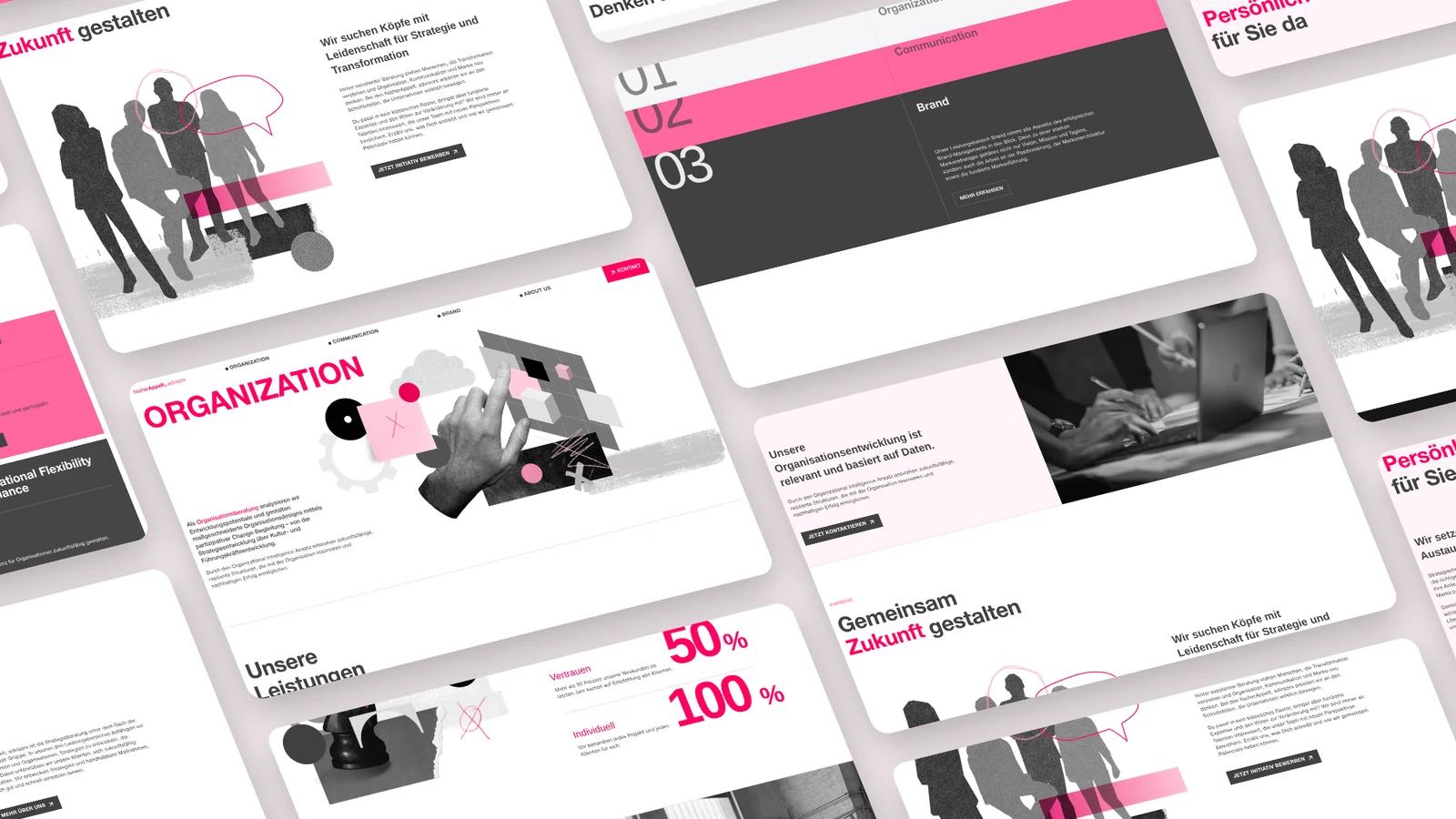
At Webwavers, a project runs through the steps on our process page: initial consultation, onboarding with a briefing (34 strategy questions), strategy session, three moodboards, the first three sections in Figma, then homepage and subpages, development and launch with training. We clarify positioning and message in the briefing and the strategy session, before the design takes shape. We define page structure and CMS collections in the technical concept before the build, as described on the web development page. We discuss which building blocks you need for your firm in the initial consultation. You can find an overview of our work for the industry on Consulting and agencies. One example is the site for the Latzer Associates Group: a web presence as a strategic communication platform, built in Webflow.
The professional-law assessment of individual wordings in a specific case is handled by your legal counsel or chamber. Webflow is our focus, we also build with WordPress and other systems and advise neutrally. Want to talk about your situation? Then use the contact page.
FAQ
Which agencies develop anonymized case studies for consultancies with confidential mandates?
You recognize good agencies by a method, not by a promise: they offer graded forms (named with approval, anonymized, case pattern, insight), work with an approval checklist, check for re-identification and state clearly that the professional-law review is your responsibility. The questions in the section "Questions for an agency" help with the evaluation.
May a law firm name clients on its website?
For lawyers, the code of conduct allows references to specific mandates or clients only with their express consent (§ 6 BORA). In addition, the duty of confidentiality under § 43a para. 2 BRAO applies. Other professional groups have different rules. Check each case with your chamber.
How anonymous is anonymous enough?
Removing the name is not enough. What matters is whether the client would be recognizable by the means reasonably likely to be used (Recital 26 GDPR as an aid to thinking). Industry, region, size, events and exact numbers can be enough together. Run a re-identification test before you publish.
What if no case study is approved at all?
Then levels 3 and 4 remain: labeled case patterns, method articles, checklists and assessments. In addition, you can collect client testimonials with name and role only if the client agrees. And you can offer to name references on request in the initial consultation.
What belongs on an expert page?
Photo, role in one sentence, focus areas, background and qualifications, selected articles and cases, and a direct path to contact. You only state titles and licenses in the permitted form. Technically, Google's ProfilePage markup suits such pages.
Can I maintain insights and expert pages in the Webflow CMS myself?
Yes, if the structure is built for it: collections for experts, case studies and insights with reference fields and clear templates. What maintenance looks like day to day is described in the guide Maintaining your Webflow CMS yourself.
Does Webwavers have references with case studies and expert pages for consultancies?
On our references page you will find the project for the Latzer Associates Group, a web presence as a strategic communication platform in Webflow. In the initial consultation, ask specifically for examples of case study templates and expert pages that fit your firm.
Conclusion
Confidential mandates are no argument against references, but a reason for a clean method. Start with positioning, build expert pages, show as many approved cases as possible, add insights and keep the structure in the CMS maintainable. The first step you can take today: write down the three completed mandates you would most like to show, and ask the clients for approval. The answer will tell you more about your strategy than any layout discussion.
Sources
- Gartner, Sales Survey, 61 Prozent der B2B-Käufer bevorzugen ein Kauferlebnis ohne Vertrieb, 25.06.2025 (61 percent of B2B buyers prefer a rep-free buying experience, June 25, 2025)
- Edelman und LinkedIn, B2B Thought Leadership Impact Report 2024
- Nielsen Norman Group, Why You Only Need to Test with 5 Users
- Google Search Central, Profile page structured data
- Google Search Central, AI features and your website
- Google Search Central, Spam Policies
- § 43a BRAO, Gesetze im Internet
- § 43b BRAO, Gesetze im Internet
- § 6 BORA, lexmea
- § 57 StBerG, Gesetze im Internet
- § 203 StGB, Gesetze im Internet
- § 5 UWG, Gesetze im Internet
- Erwägungsgrund 26 DSGVO (Recital 26 GDPR)
- Art. 9 DSGVO (Art. 9 GDPR)
- Webwavers, Process
- Webwavers, Web development
- Webwavers, Consulting and agencies
- Webwavers, Latzer Associates Group
More guides
All guides
PHP2Shell: Is your TYPO3 or WordPress website affected? What you need to do now
Oct 21, 2026
Read more



Branding Agency, Freelancer or In-House: What Pays Off for Mid-Sized Companies?
Oct 31, 2026
Read more


GEO for B2B Industries: How Expert Content Gets Cited in ChatGPT and Perplexity
Oct 31, 2026
Read more


Wix, Squarespace, Jimdo or Webflow: Which Platform Can Carry a Company Website?
Oct 31, 2026
Read more