Branding
Branding Agency, Freelancer or In-House: What Pays Off for Mid-Sized Companies?


Key takeaways
- For a one-time brand relaunch at a mid-sized company, a specialized branding agency is usually the most dependable choice, and a freelance designer fits clearly defined tasks
- In the 3-year cost model, freelancers come to €16,800 to €42,000, a branding agency to €34,200 to €76,000 and an in-house graphic designer to about €157,000
- In-house only pays off from roughly 260 to 580 externally purchased design hours per year
- There is no reliable public market range for branding, so the model is based on hourly rates and freely chosen effort assumptions
- Usage rights under § 31 (5) UrhG (German Copyright Act) should be settled in writing before the project starts
Short answer: For a one-time brand relaunch with strategy, brand system and rollout at a mid-sized company, a specialized branding agency is usually the most dependable choice. A freelance designer fits when the brand and the tasks are clearly defined. In-house only pays off when you have a lot of design work on a permanent basis. A classic ad agency is mainly suited to cases where campaigns come first, not the brand itself.
The key points
- There are four models: branding agency, freelance designer, in-house designer, ad agency. They solve different problems.
- The hourly rate tells you little. What matters is how many hours go into strategy, coordination and rollout, and who carries the risk.
- According to our cost model, in-house pays off from roughly 260 to 580 externally purchased design hours per year.
- The most important selection criteria: process, a fixed point of contact, approval rounds, usage rights, references that show systems thinking.
- There are cases where you do not need an agency at all.
Contents
- The four models at a glance
- Which model fits when?
- What does it cost over three years? A cost model
- Branding agency or ad agency?
- Risks by model
- Ten questions for vetting providers
- Step by step to a decision
- Common mistakes
- When you do not need an agency
- How we approach this
- FAQ
The four models at a glance
When people plan a rebrand, they usually ask about price first. The better question is which task you are actually handing out. A brand has several layers: positioning, name, mark, color, typeface, imagery, tone of voice, rules for application. Some providers cover only the top layer, the logo. Others deliver a system that a team can apply afterward without follow-up questions. For what separates a brand system from a logo, see the article Brand system, not just a logo.
Branding agency. A team covering strategy, design and often implementation. Typical features are a defined process with approval phases, a fixed point of contact, workshops and a brand guide at the end. Strength: breadth and reliability. Weakness: higher hourly rates and more coordination.
Freelance designer or branding designer. One person who handles light strategy, design and file handover. Strength: short lines of communication, direct contact, often a clearly defined deliverable such as a logo with basic guidelines. Weakness: dependence on one person, limited capacity, rarely any in-house strategy or web expertise.
In-house designer. A permanent hire. Strength: brand knowledge inside the company, speed in day-to-day work, continuity. Weakness: fixed costs, hard to replace when the person is out, and a single designer replaces neither strategy nor brand development at agency level.
Ad agency (full service). An agency that bundles campaigns, media, copy and design. Strength: broad range of services, campaign routine. Weakness: branding is sometimes a by-product of the campaign, not the core business.
There are hybrids in between. Many companies combine a branding agency for brand development with an in-house designer for everyday work. That is often the smartest solution, because you buy the brand build and handle the upkeep yourself.
Which model fits when?
The table maps typical situations to a model. It is a rule of thumb, not a law.
| Situation | Obvious choice | Why |
|---|---|---|
| New brand or rebrand with positioning, 30 to 500 employees | Branding agency | Strategy, system and rollout in one process, predictable approvals |
| Brand is set, only a logo refresh and a small guideline are missing | Freelance designer | Clearly defined task, manageable effort |
| Permanently high design volume (trade shows, print, social, sales) | In-house, supplemented by an agency for brand development | Utilization justifies a permanent hire |
| Campaign launch with a media budget, brand is already clear | Ad agency | The campaign is the task |
| Brand and website are being rebuilt at the same time | An agency that combines both | Fewer handover losses, see Branding and website from a single source |
| Start-up with a small budget and an early product phase | Freelance designer or small studio, upgrade later | The brand is still changing, a system would be premature |
| Corporate brand with a brand team and an existing design system | In-house plus agencies for specific jobs | Governance sits inside the company |
The third column matters more than the second. If you understand why a model fits, you can apply the rule to your own case.
What does it cost over three years? A cost model
A preliminary note: there is no reliable, publicly verifiable market range for branding and corporate design. The big price comparisons cover websites, not brands. So we calculate transparently with hourly rates and effort assumptions, so you can plug in your own numbers. The result is a model, not a price list.
Hourly rates from sources (net, 2026):
- Agency: €80 to €120 per hour for Webflow and web design projects (Adfera, 2026), €90 to €200 (Freelancermap, 2026). According to Tricks.de, the average for classic ad agencies is around €120.
- Freelancer: €60 to €90 for web design and development (Adfera, 2026), €75 to €150 in general (Evergreen Media, 2026).
- In-house: According to Gehalt.de, the median gross salary of a graphic designer is €43,598 per year, and of an art director €57,071.
The Vergütungstarifvertrag Design (VTV Design, the design compensation agreement) of the Allianz deutscher Designer (AGD), which serves as a calculation aid for design services, provides benchmark values by type of service. If you want to cross-check a quote, you can use it as a reality check.
Assumptions for our example (freely chosen, change them for your case):
- Mid-sized company, brand relaunch with positioning, logo, colors, typeface, imagery rules and brand guide
- Freelancer: 200 hours, because one person does everything and coordination is shorter
- Agency: 300 hours, because a team works with workshops, strategy and quality assurance
- In years 2 and 3: 40 hours each for maintenance and extensions
- In-house: gross salary plus 20 percent employer share (assumption, approximation), excluding workstation, software and training
Calculation:
| Model | Year 1 (project) | Years 2 and 3 (maintenance) | Total over 3 years |
|---|---|---|---|
| Freelancer (200 hrs at €60 to €150) | €12,000 to €30,000 | €4,800 to €12,000 | €16,800 to €42,000 |
| Branding agency (300 hrs at €90 to €200) | €27,000 to €60,000 | €7,200 to €16,000 | €34,200 to €76,000 |
| In-house graphic designer (median €43,598 plus 20%) | about €52,300 | about €104,600 | about €157,000 |
The result reads like this: for a one-time project, in-house is the most expensive route, because you pay a full annual salary even when the person is not fully utilized. The freelancer is the cheapest, and the agency sits in the middle to upper range. That says nothing yet about quality or risk, more on that in the next section.
When in-house becomes cheaper after all: By our assumption, an in-house designer costs about €52,300 per year. Divide that by the external hourly rate and you get the number of hours above which in-house is cheaper: €52,300 divided by €200 is about 260 hours, divided by €90 about 580 hours. If you need more external design hours every year than this threshold, a permanent hire pays off, at least on cost. As a plausibility check: average labor costs in Germany in 2024 were €43.40 per hour worked (Destatis, cited by Vergabeblog). A designer costs you more than this average, because qualification and workstation come on top.
What the model does not capture:
- Usage rights and additional costs such as font licenses or image rights
- The risk of rework when a result does not hold up
- Opportunity costs from delays
- The effect of the brand itself. A strong presence can pay off through sales, recruiting and price realization, but that can hardly be quantified in advance in any serious way.
Branding agency or ad agency?
Many mid-sized companies turn to their ad agency first for a rebrand. That is understandable, because trust and processes are already in place. The difference lies in the focus.
| Criterion | Specialized branding agency | Full-service ad agency |
|---|---|---|
| Core business | Brand strategy and brand system | Campaigns, media, content |
| Typical result | Positioning, brand system, brand guide | Campaign idea, creative, media plan |
| Time horizon | Project with a start and an end | Often ongoing support |
| Fee model | Project price, phases | Retainer, commission, hourly rates |
| Strength | Consistency across all channels | Reach and activation |
| Typical risk | No routine for activation | Brand is subordinated to campaigns |
This is not a ranking, it is a division of labor. For a brand relaunch, an ad agency is a good option if it can show that it has built brand systems and not only campaigns. Ask for examples where the brand guide and its application still work after 12 months. A branding agency that has never run a campaign, in turn, is only a good choice if you handle activation yourself or with partners.
For an overview of what a complete corporate design includes, see the article Corporate design. For the cost factors of a corporate design, see Corporate design costs.
Risks by model
Every model has a typical risk. If you know it, you can cover it contractually and organizationally.
| Model | Typical risk | Countermeasure |
|---|---|---|
| Freelance designer | Absence, capacity, no plan B | Source files and fonts at handover, substitute arrangement, milestones |
| Freelance designer | Usage rights unclear | Put the transfer of rights in writing (see below) |
| Branding agency | Strategy becomes a slide deck with no link to daily work | Workshops with sales, application test on real examples |
| Branding agency | Price lacks transparency | Phased quote with defined scope and revision rounds |
| In-house | A single person becomes the bottleneck | Documented brand guide, development budget, external sparring partners |
| In-house | Blind spots from being too close to the brand | External review every two to three years |
| Ad agency | Brand takes a back seat to the campaign | Set the brand standard in writing up front, approval by the brand owner |
Usage rights. In copyright law, the purpose-of-transfer principle applies: if the agreement does not expressly state which types of use are granted, the shared purpose of the contract decides (§ 31 (5) UrhG, German Copyright Act). That is tricky with logos and imagery, because the purpose is often interpreted more narrowly than you would like. So have scope, duration, territory and the right to modify confirmed in writing, ideally exclusive and unlimited in time for all media. This applies to every external provider, not just freelancers.
Trademark law. A new logo or name should be searched before rollout, for example in the register of the German Patent and Trade Mark Office (DPMA). This does not replace a legal review. Plan one if the brand is to be protected.
Legal classification of freelancers. If you work with individuals on an ongoing basis and subject to instructions within a team, you should clarify whether that counts as self-employment. The German Pension Insurance (Deutsche Rentenversicherung) offers a status determination procedure (Statusfeststellungsverfahren) for this. For clearly defined project assignments, such as a brand relaunch with a defined result, this is usually not a problem. If you are unsure, get advice.
Ten questions for vetting providers
This checklist works for all four models. It gives you a feel for quality faster than price comparisons do.
- What phases does your process have, and where are the approval points? Good providers name phases, deliverables and approvals without hesitation.
- Who is my fixed point of contact? A named person who is actually reachable.
- How many rounds of revisions are included in the quote? And what happens after that?
- What exactly do I get at the end? Files, formats, brand guide, font licenses, templates.
- What does a brand guide from you look like? Ask to see an anonymized example. A guide that contains nothing but logo clear space is not a system.
- Can you show me projects where the brand is applied in daily use? Not just the pitch image, but website, print, social, sales.
- Who owns which rights in the end? Usage, modification, source files.
- How do you handle brand and website? If you want to renew both: who implements, who hands over, how is it checked?
- What happens if the responsible person is out? Substitute, documentation, handover.
- How long does the brand hold up without your help? An honest provider names the upkeep effort and says when you will need someone again.
One warning sign is providers promising results they cannot influence, such as revenue growth or rankings from a new logo. A good sign is follow-up questions about target groups, sales and competition before a quote arrives.
Step by step to a decision
- Name the task. Write in three sentences what should change and what should stay. Without this step, you are only comparing gut feelings.
- Clarify the scope. Logo only, brand system, brand system plus website? The larger the scope, the more an agency makes sense.
- Set budget and timeframe. Give a range, not a wish price. Providers can then honestly tell you what is possible for it.
- Check internal capacity. Who delivers the briefing, who approves, who coordinates the rollout? If nobody does, you need more project leadership from the provider.
- Talk to three providers. A mix of the models brings the most, for example an agency, a studio and a freelance designer.
- Compare conversations, not just quotes. Who asks the better questions? Who understands your business?
- Small test. If possible: a paid mini-workshop or an analysis phase before the main contract.
- Contract with rights and phases. Usage rights, milestones, revision rounds and handover scope in writing.
Common mistakes
- Choosing the lowest hourly rate. A low rate with long coordination loops is rarely cheaper than a higher rate with a clear process.
- Confusing a logo with a brand. A pretty mark solves neither positioning nor consistency.
- Rebrand and website separated, without a bridge. Then the web rules are missing from the brand guide. More in the article Rebranding: when it makes sense.
- Starting without a decision-maker. When five people have a say, every round ends in a compromise.
- No plan for the rollout. Business cards, vehicles, trade show booths, email signatures, presentations. Plan the changeover with a sequence and a budget.
- Forgetting the rights. Especially for imagery and typefaces.
- Hiring in-house without defining the tasks. A position that mostly collects requests from every department burns out quickly.
When you do not need an agency
There are situations where any agency is too much:
- You are in an early phase and do not yet know what you stand for. Then a brand system costs money you are better off investing in product and sales.
- Your brand is solid and the problem lies elsewhere, such as the website, sales or the offer.
- A refresh is enough: a current typeface, cleaned-up colors, well-kept templates. An experienced designer can often manage that in a short time.
- You have a strong design team in-house that only needs input. Then strategy sparring is enough.
We answer the question of when a rebrand really makes sense in the article Rebranding: when it makes sense. Consultancies, law firms and agencies have their own particularities, which Branding for professional services describes.
How we approach this
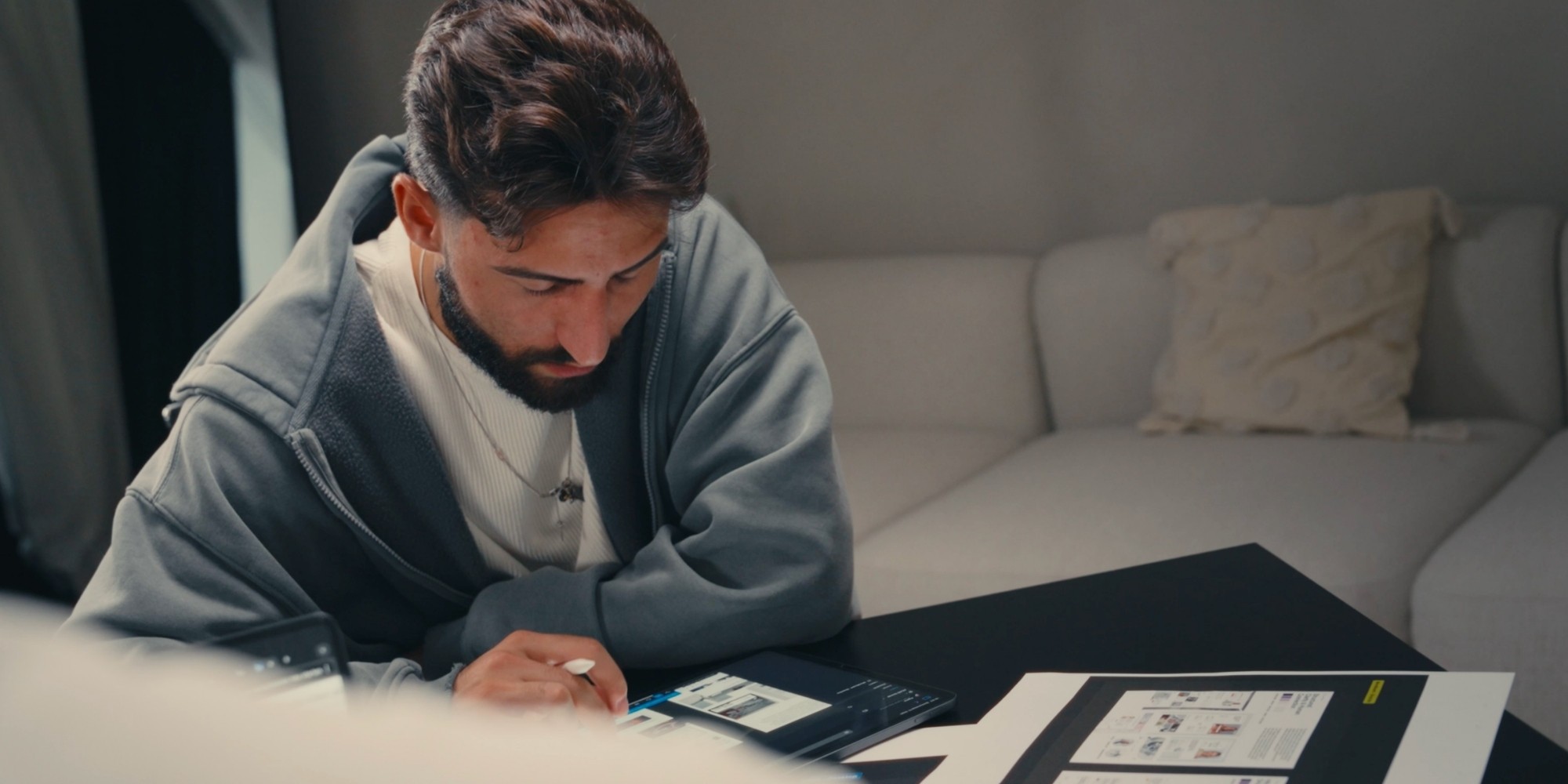
Webwavers develops brands as brand systems and, when needed, implements them as a website in Webflow within the same project. You get a fixed point of contact, a process with approval after every phase and a brand guide that your team and external service providers can work with. At the German Brand Award 2026, our work for the Dualis53 brand was recognized with an award. You can find more about the service on the Branding page. If you want to renew brand and website together, read Branding and website from a single source.
FAQ
Is the premium for a branding agency worth it compared with a cheap logo designer?
It depends on what you are ordering. For a logo alone, a cheap designer is often enough. The agency premium pays for strategy, a brand system with rules for application and reliability in the process. If your team is supposed to apply the brand afterward without follow-up questions, the premium usually pays off. Calculate the total effort, not the hourly rate.
Branding agency or freelance branding designer: which fits our rebranding better?
A freelance designer fits clearly defined tasks with a budget cap, such as a logo refresh plus basic guidelines. An agency fits when positioning, brand system and rollout come together and several stakeholders are involved. In both cases, check process, point of contact, approval rounds and usage rights.
Is a specialized branding agency better than a full-service ad agency for our brand relaunch?
For the relaunch itself, often yes, because brand systems are their core business. For the activation that follows, with campaigns and media, the ad agency is stronger. What matters are references for brand systems, not the type of agency. Some companies combine both: a branding agency for the brand, an ad agency for the campaign.
Brand identity from an agency or from an in-house designer: what pays off for a mid-sized company?
For the one-time build, the agency usually pays off, because you do not pay a full annual salary for one project. For ongoing application, in-house pays off if you buy more than roughly 260 to 580 external design hours per year (cost model above). The combination is often the most sensible.
Which branding designers work with a fixed point of contact and clear approval rounds?
You can only check that in conversation. Ask about the process with phases, about named support, about the number of revision rounds and about what happens after a round is closed. Reputable providers answer this without hesitation and put it in writing in the quote.
Which branding agencies offer better value for money in a rebrand than freelance designers?
There is no blanket answer. Freelance designers are cheaper per hour, agencies need more hours but bring a team, strategy and a safety net. Value for money comes from the result per euro: do you get a system that holds up, or a mark you have to fix later? Work through the model above and ask for brand guide examples.
Which corporate identity agencies are better suited for a rebrand than classic ad agencies?
Better suited are agencies that treat brand strategy and brand systems as their core service and can back that up with projects where the brand works in daily use. They are more specialized in developing the brand. Ad agencies remain the right choice when campaigns are the focus.
Conclusion
The question of agency, freelancer or in-house is really a question of task, risk and duration. For a one-time brand build with strategy and system, the specialized agency is usually the safer route, for clearly limited tasks a freelance designer is enough, and in-house only pays off with permanent utilization. Calculate with your own numbers, check process and rights, and ask to be shown what a brand looks like in daily use after a year.
Support with your brand relaunch: If you want to talk to us about brand and website, you will find everything important on the Branding page or directly via Contact.
Sources
- Adfera: Website-Kosten-Report 2026 (Stundensätze Agentur und Freelancer) (website cost report 2026, agency and freelancer hourly rates)
- Freelancermap: Stundensätze und Agenturpreise (September 2026) (hourly rates and agency prices)
- Tricks.de: Website Agentur Kosten und Preise (2026) (website agency costs and prices)
- Evergreen Media: SEO-Kosten, Freelancer-Stundensätze (Oktober 2026) (SEO costs, freelancer hourly rates)
- Gehalt.de: Grafikdesigner/-in, Gehalt in Deutschland (graphic designer salary in Germany)
- Gehalt.de: Art Director, Gehalt in Deutschland (art director salary in Germany)
- Vergabeblog: Arbeitskosten in Deutschland 2024 (Destatis) (labor costs in Germany 2024)
- AGD / Bayern Design: Kalkulationstool VTV Design 2021 (calculation tool)
- Gesetze im Internet: § 31 UrhG, Einräumung von Nutzungsrechten (granting of usage rights)
- Deutsche Rentenversicherung: Statusfeststellung (status determination)
- Deutsches Patent- und Markenamt (German Patent and Trade Mark Office)
- Webwavers: German Brand Award 2026, Dualis53
More guides
All guides
PHP2Shell: Is your TYPO3 or WordPress website affected? What you need to do now
Oct 21, 2026
Read more


Branding Agency, Freelancer or In-House: What Pays Off for Mid-Sized Companies?
Oct 31, 2026
Read more


GEO for B2B Industries: How Expert Content Gets Cited in ChatGPT and Perplexity
Oct 31, 2026
Read more


Wix, Squarespace, Jimdo or Webflow: Which Platform Can Carry a Company Website?
Oct 31, 2026
Read more