SEO & Visibility
Outbound Is Saturated in the Trades: How Customers and Skilled Workers Find Businesses Today


Key takeaways
- According to Bitkom, 83% of consumers find tradespeople through personal recommendations, 26% through company websites, and 40% treat a missing website as a dealbreaker (Bitkom, 2025)
- In 2025 the German skilled trades had around 1.04 million businesses with 6.24 million employees, which works out to 12.4 businesses per 1,000 inhabitants (ZDH)
- In the trades, 209,444 open positions faced 139,239 unemployed skilled workers, and the occupation-specific skilled-labor gap is 97,482 (KOFA, IW Köln, 2025)
- 94% of trades businesses have a website, but only 4% use AI and 84% say AI is not a topic for them (Bitkom, 2025)
- Cold emails require prior explicit consent, and so do phone calls to consumers (Section 7 UWG)
Short answer: In the trades, a cold outreach message rarely decides anything. A referral does, followed by the check that comes after it. According to Bitkom, 83% of consumers find tradespeople through personal recommendations, and 40% rule out businesses without a website. If you want to win jobs and skilled workers, you don't need louder messages. You need a website that gets found locally and shows at first glance what your business can do.
Key takeaways
- The trades are a huge, fragmented market: around 1.04 million businesses in Germany, and in every town many of them share the same trade (ZDH 2025).
- Customers come mainly through referrals (83%), then they look online. Websites are used by 26%, reviews by 15%, platforms by 20% (Bitkom 2025, multiple answers allowed).
- Almost every business has a website (94%), but only 4% use AI. If you think about AI answers early, you have a head start.
- The second challenge is staffing: the trades are short 97,482 skilled workers (KOFA 2025). Applicants check out the business in advance, too.
- Cold calls and cold emails are regulated more tightly than everyday practice suggests (Section 7 UWG, the German Unfair Competition Act).
This guide goes deeper into the pillar topic Outbound Is Saturated: Why Decision-Makers Find Vendors Through AI Search. The general response rates and buyer studies are covered there. Here the question is what applies to trades businesses, workshops and commercial companies.
Why "Saturated" Has Two Sides in the Trades
In the trades, the topic affects businesses twice. On one side, they are recipients: software vendors, portals, marketing service providers and sales agencies approach business owners who have little time for messages between the job site and the office. That is an observation from daily practice, not a measured number. On the other side, businesses are senders, for example when they approach property managers, developers, industrial customers or planners to win framework contracts.
There is also a second target group that hardly matters in other industries: applicants. Businesses don't just look for customers. They also look for journeymen, master craftspeople and apprentices, and the competition for them is tougher than the competition for jobs. That is why this guide covers both.
What the general studies on vendor search say applies here with one caveat: the large buyer studies from Gartner, 6sense and Forrester survey B2B buyers, mostly in software. They don't exist for private customers and small commercial customers in the trades. Where industry-specific numbers exist, they are used here.
The Market in Numbers: Many Businesses, Tough Competition
The German Confederation of Skilled Crafts (ZDH, Zentralverband des Deutschen Handwerks) reports the following key figures for 2025 (as of June 2026):
| Key figure | Value 2025 | Source |
|---|---|---|
| Trades businesses | 1,038,126 | ZDH |
| Employees | 6,237,000 (minus 1.3%) | ZDH |
| Revenue excluding VAT | €783 billion (plus 1.2%, estimated, nominal) | ZDH |
| Apprentices | 346,388 (minus 1.3%) | ZDH |
| New apprenticeship contracts | 132,576 (plus 1.0%) | ZDH |
| Businesses per 1,000 inhabitants | 12.4 | ZDH |
A worked example makes the density tangible. At 12.4 businesses per 1,000 inhabitants, a town of 30,000 people has roughly 372 trades businesses across all trades. That is an average calculation that ignores individual trades and the surrounding area, but it shows how much supply competes in a region. A customer looking for heating, roofing or electrical work usually has several businesses to choose from, and the question is not "is there anyone?" but "who do I trust?".
That explains why cold outreach is rarely the most efficient route in the trades. Demand usually arises suddenly and concretely: the roof is leaking, the heating fails, the extension needs planning. These people are searching right now, and they search where they can find trust quickly.
How Customers Actually Find Tradespeople
The best source is the representative Bitkom survey on finding tradespeople (1,004 people aged 16 and older in Germany, surveyed in calendar weeks 7 to 10 of 2025, published on June 12, 2025). It asked how people look for trades businesses.
| Way to find a tradesperson | Share of respondents | Note |
|---|---|---|
| Personal recommendation (friends, family, colleagues) | 83% | Multiple answers possible |
| Asking directly at the business on site | 41% | |
| Websites of possible businesses | 26% | |
| Print ads (Yellow Pages, notices) | 23% | |
| Online platforms (e.g. myhammer.de) | 20% | |
| Online customer reviews | 15% | |
| Social networks | 14% |
Further figures from the same survey: 55% say digital offerings make trades businesses more attractive, and 40% see a missing website as a dealbreaker (Bitkom, June 2025). According to the press release, Google as a search route of its own was not asked about separately, so no figure exists for it.
How should you read this?
A referral is the starting point, not the end. 83% start with a referral. But a referral is a name, and then comes the check: What does the business look like, can I reach it, are there references, what do others say? That is exactly the phase in which the website does its work. The 40% who rule out a business without a website show how seriously this check is taken.
The numbers are a consumer perspective. The survey covers private individuals. There is no reliable current source on how commercial customers, property managers or developers choose trades businesses. The general B2B studies allow only indirect conclusions: Gartner reports that 67% of B2B buyers prefer a buying experience without a sales rep (March 2026), and 6sense reports that 94% of buying groups had ranked their preferred vendors before first contact (Buyer Experience Report 2025). Whether this holds with the same force for a single trade is an open question.
AI search is the new intermediate step. According to Bitkom, half of Germans use AI chats for internet search at least occasionally (Bitkom, November 2025, a population figure, not specific to the trades). It is plausible that someone types "Who reliably repairs roof windows in my town?" into an assistant. How often that happens for trades services has not been measured. You can check it yourself, though, and the test takes ten minutes (see the section on the 90-day plan).
How Businesses Are Set Up Today
The Bitkom study on the trades (504 trades companies, by phone, calendar weeks 23 to 29 of 2025, margin of error plus/minus 4 percentage points) shows the business side:
| Characteristic | Share of businesses |
|---|---|
| Own website | 94% |
| Listing in online directories such as Google or Gelbeseiten.de | 88% |
| Social media or advertising there | 56% |
| Presence on review platforms | 40% |
| See online customer reviews as a big opportunity | 72% |
| At least one digital service | 85% |
| Already use AI | 4% |
| Plan to use AI | 9% |
| Say AI is not a topic | 84% |
Two things stand out. First, the website is nearly standard. On its own it no longer sets you apart. The difference is quality: a page that shows right away which service the business provides in which service area, with photos of real work, references and a short inquiry form, feels different from a business card with a phone number. Second, 84% of businesses are not dealing with AI. If you understand early how assistants recommend businesses, you belong to a small group.
That is an opportunity, but not a guarantee. We have not found a study showing how many inquiries in the trades come from AI assistants. The direction is plausible, the scale is open.
Outbound in the Trades: Where It Stalls
Depending on the business, outbound means something different. Three typical forms:
- Cold outreach to commercial customers. Letters, calls or LinkedIn messages to property managers, developers, planners or industrial companies. The general rates apply here: Hunter measures an average 4.1% reply rate for cold email campaigns, 5.8% for campaigns of up to 50 recipients and 2.1% from 1,000 recipients (Hunter, State of Cold Email 2025, global data, vendor benchmark). A hypothetical example: 100 well-prepared messages at 4.1% yield about four replies, including rejections. For a business that is short on time anyway, that is a poor ratio.
- Paid ads and lead portals. They deliver contacts quickly, but your competitors sit in the same auctions and the same portals. The Bitkom survey shows that online platforms are a route to a tradesperson for only 20% of consumers. There are no reliable data series on cost per inquiry in the trades. The cost-per-lead calculator lets you calculate with your own values.
- Phone and door-to-door with private customers. This is the most heavily regulated route.
The Legal Framework Is Tighter Than Many Think
This is not legal advice but an orientation based on the text of the law. Section 7 (2) UWG lists cases in which an unreasonable nuisance is always assumed:
- Advertising by phone call to a consumer without their prior explicit consent (no. 1),
- advertising by phone call to another market participant, such as a company, without at least their presumed consent (no. 1),
- advertising using electronic mail without the recipient's prior explicit consent (no. 2).
The IHK Niederrhein (Lower Rhine Chamber of Commerce) explains in its information sheet (as of March 2022) that even toward companies, an email address from a business card does not count as consent, and that presumed consent for phone advertising requires concrete circumstances that suggest a genuine interest. Using the address of an existing customer under narrow conditions is governed by Section 7 (3) UWG. The section numbering in the information sheet comes from the version before the amendment of the law, and the statement still holds in substance.
For trades businesses, this means in practice: a mailed form letter to property managers is a different world from a cold email sequence. If you approach commercial customers, choose routes based on consent and relevance: referrals, trade fair contacts, existing customers, taking part in tenders, and a website through which contact comes to you.
The Second Challenge: Finding Skilled Workers
In the trades, the question "How do I reach the right people?" is not only a customer question. The staffing numbers are clear:
- According to KOFA Kompakt 07/2026 (IW Köln, 2025 data), 209,444 open positions in the trades faced 139,239 unemployed skilled workers. The skilled-labor gap is 97,482, which is almost every other open position. It is calculated by occupation (a roofer cannot fill an optician's job) and is therefore larger than the simple difference between the two numbers. 59 of 115 trades occupations are shortage occupations. Compared with the previous year, the gap fell by 9.5% in the trades and by 24.1% across all occupations.
- In training, 2025 saw 133,197 new apprenticeship contracts according to KOFA (2011: 150,747), while unfilled apprenticeship places rose from around 5,000 in 2011 to around 21,571 in 2025. From these two KOFA values, roughly 14% of the places on offer went unfilled (our own calculation: 21,571 divided by the sum of 133,197 and 21,571).
- In the Bitkom business survey, 75% of businesses see the skilled-labor shortage as a central problem and 83% see the shortage of apprentices as a challenge (Bitkom 2025). 80% of training businesses use digital media to reach apprentices (Bitkom, August 2025).
The pattern resembles the customer side. Applicants also get recommendations, but then they look: What does the business look like, what is the atmosphere, what does it pay, how does applying work? There is no study showing how applicants in the trades research today or whether they use AI assistants. The Bitkom figure does show, however, that businesses themselves rely on digital channels.
The connection to outbound: a business that reaches customers and applicants through the same channel saves effort. A careers page with open positions, a look at daily life and an application without hurdles is therefore not a side project. More on this in the guide Careers Page: Win More Applications and in the article Careers Page for Apprentices in the Trades.
Checklist: What a Trades Business Website Must Do
| Check | Why it matters | Typical flaw |
|---|---|---|
| Service and service area in the first sentences | Searchers want to know immediately whether you fit | Slogan without location or trade |
| Own page per service with a local reference | Whoever asks gets the matching page named | Everything on one services page |
| References with photos, location and task | After the referral comes the check | Gallery without descriptions |
| Real photos of the team and the work | Trust comes from people | Stock images |
| Reviews visible and current | A search route for 15% of consumers, an opportunity for 72% of businesses (Bitkom) | Only a Google listing, no replies |
| Short inquiry form, ideally with photo upload | Quick assessment without follow-up questions | Long form |
| Phone number, opening hours, emergency service note | Urgent jobs are decided in minutes | Number hidden |
| Up-to-date directory listings (88% have them, Bitkom) | Consistent details strengthen findability | Differing addresses or hours |
| Careers page with open positions and a clear application | 83% of businesses see the apprentice shortage (Bitkom) | Jobs only on portals |
| References and jobs you can maintain yourself | Stays current without an agency | A site nobody touches |
| Privacy policy, Impressum (legal notice), cookie notice correct | Mandatory, and basic trust | Outdated texts |
For local findability, see the article Local SEO for B2B and the article Local SEO and Service Pages in the Trades.
What Businesses Can Do Concretely in 90 Days
This plan is deliberately small, because trades businesses rarely have a marketing team.
- Ten-minute test (week 1). Ask ChatGPT, Perplexity and Google AI Mode about your trade in your town, for example "Which electrical contractor in [town] is recommended for commercial customers?" Note who is named, and with which sources. That is your baseline.
- Clean up your own data (weeks 1 to 3). Name, address, phone number, opening hours and services must match in your Google Business Profile, in directories and on your website.
- One page per core service (weeks 3 to 8). A short answer at the top (what, where, for whom), then the process, references with photos, frequently asked questions and an inquiry form. No made-up questions, only the ones customers ask you on the phone.
- Collect reviews systematically (ongoing). After every completed job, send a short message with the link. This is the only way to build the reviews that 72% of businesses see as an opportunity.
- Rework the careers page (weeks 5 to 10). Open positions, daily life at the business, how applying works, a contact person. First the basics, then possibly an apprentice film.
- Measure the effect (from week 8). Ask every inquiry how the person found you, and check referral sources in your analytics. The method is in the article Measure AI Visibility, and Show Up in ChatGPT gives you the starting point.
When Outbound and Paid Routes Still Fit in the Trades
It would be wrong to demonize everything active. In these cases, personal outreach or ads make sense:
- Framework contracts with clear contacts. A small number of property managers or developers in the region can be approached personally, ideally after a referral or an introduction at a meeting.
- A new service or a new location. If nobody is searching for you yet, visibility helps only to a limited degree. Ads, flyers, presence on site and press work make sense here.
- Seasonal peaks and emergency service. If you need capacity utilization at short notice, you book ads and portals.
- Existing contacts. Informing existing customers is different from cold outreach, as long as the legal requirements are met.
Conversely, visibility in AI answers is no automatic win in the trades. The data on usage for trades services is thin, and the effect on jobs has not been measured. The direction is plausible, the scale is open.
How We Do This
Webwavers is a premium agency for branding, web design and web development with locations in Günzburg and Munich, and one of seven Webflow Premium Partners in Germany. For trades and commercial companies, the goal is a website that shows quality at first glance, brings inquiries and applications, and is easy to maintain. Examples from our work:
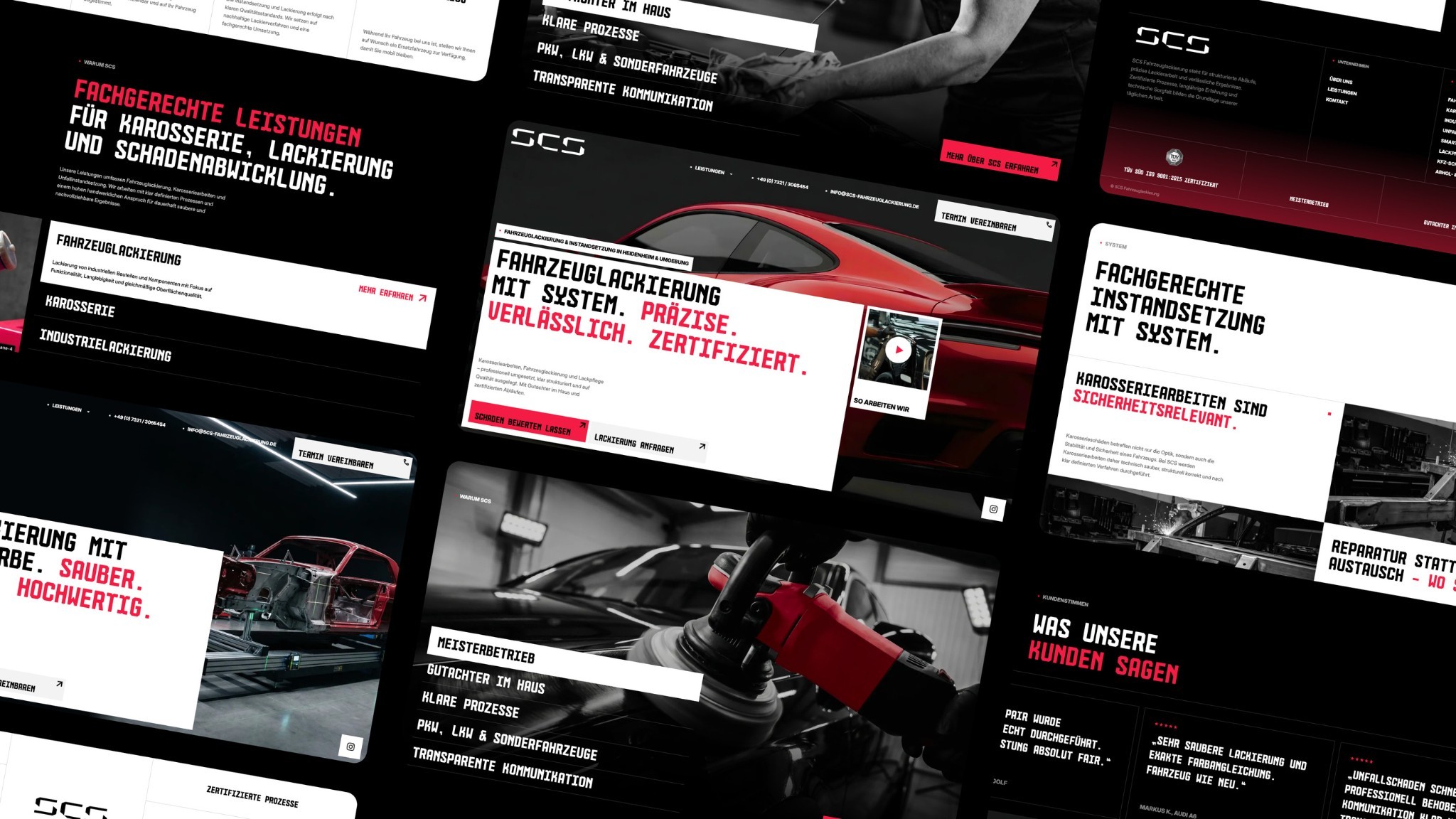
- SCS Fahrzeuglackierung (2026): Corporate identity for a vehicle painter that wants to present itself as a reliable partner for private and commercial customers, with a reduced, high-contrast visual language. More on the project page SCS Fahrzeuglackierung.
- Höbel (2024): Image film for Ernst Höbel GmbH, a construction company, with an apprentice film on four training occupations and a 20-second cinema spot in the ice stadium for regional visibility. More on the project page Höbel.
The project process is described on our Process page: initial call, briefing with 34 strategy questions, strategy session, three mood boards, the first three sections of the homepage in Figma, design with a feedback round per milestone, development after final approval in Webflow, Framer or WordPress, then launch and training so you can maintain the site yourself. We advise neutrally on which platform suits you. The industry page is called Trades and Crafts, and for visibility in AI answers there is the page GEO and AI Visibility.

Frequently Asked Questions
How do customers find tradespeople today?
According to Bitkom (1,004 respondents, June 2025), mainly through personal recommendation (83%), then through information on site (41%), business websites (26%), print ads (23%), online platforms (20%), online reviews (15%) and social networks (14%). Multiple answers were possible. 40% see a missing website as a dealbreaker.
Is cold outreach worth it for trades businesses?
Rarely as a mass measure. Hunter measures an average 4.1% reply rate for cold email campaigns, only 2.1% from 1,000 recipients, and for phone and email, Section 7 UWG sets narrow limits. Referrals, existing customers, personal meetings and a website through which inquiries arrive on their own make more sense.
Can I just call or write to private customers?
No. Phone advertising to consumers requires prior explicit consent (Section 7 (2) no. 1 UWG), and so does advertising by email (no. 2). Toward companies, phone advertising requires only presumed consent, which has to be tied to concrete circumstances. This is an orientation based on the text of the law and does not replace legal advice.
Do customers use ChatGPT to look for a tradesperson?
No figures exist specifically for trades services. In general, half of Germans use AI chats for internet search at least occasionally (Bitkom, November 2025). You can test it for your own town: ask the question a customer would ask and see who gets named.
Do I even need a website as a small business?
Yes. According to Bitkom, 40% of consumers see a missing website as a dealbreaker, and 94% of trades businesses already have one. The site doesn't have to be big, but it should show your service, service area, references and a simple way to get in touch.
How do I find apprentices and skilled workers through the website?
With a careers page that shows open positions, a look at daily life and a simple application. The need is large: 97,482 missing skilled workers in the trades in 2025 (KOFA), and 83% of businesses name the apprentice shortage as a challenge (Bitkom). There is no dedicated study on how applicants research.
Should I cancel lead portals and ads?
Not across the board. They deliver inquiries quickly. The combination makes sense: portals and ads as a bridge, while you build your own website, reviews and service pages that later deliver inquiries without a cost per click. With the cost-per-lead calculator you can check this with your own values.
Conclusion
In the trades, volume doesn't decide. Trust on site does. Customers come through referrals and then check online, and 40% rule out businesses without a website. Competition is dense, and cold outreach runs into legal limits and full inboxes. Almost every business has a website, and few think about AI answers. If you clearly show your service, location, references and a simple inquiry form, you are more likely to be found and more likely to be chosen, by customers and by applicants. The first step takes ten minutes: ask the AI about your trade in your town and see whether you get named.
Support With AI Visibility
If you want to know how your business shows up in AI answers and with applicants, get in touch via the contact page. The Growth service page gives an overview.
Sources
- ZDH: Wirtschaftlicher Stellenwert des Handwerks 2025 (Economic Significance of the Skilled Trades 2025)
- Bitkom: Bei der Handwerkersuche schlägt das Gespräch das Netz (When Searching for Tradespeople, Conversation Beats the Web) (June 12, 2025)
- Bitkom: Studienbericht Handwerk (Study Report on the Trades) (2025)
- Bitkom: Handwerk, Azubis, Betriebe und Digitalisierung (Trades, Apprentices, Businesses and Digitalization) (August 2025)
- Bitkom: Internet-Suche im Wandel, die Hälfte nutzt KI-Chats (Internet Search in Transition, Half Use AI Chats) (November 20, 2025)
- IW Köln: KOFA Kompakt 07/2026, Handwerk (Trades)
- Hunter.io: The State of Cold Email 2025
- Gartner: 67% of B2B Buyers Prefer a Rep-Free Buying Experience (March 9, 2026)
- 6sense 2025 B2B Buyer Experience Report, press release (November 12, 2025)
- Gesetze im Internet: § 7 UWG, Unzumutbare Belästigungen (Unreasonable Nuisances)
- IHK Niederrhein: Merkblatt Werbung per Telefon, Brief und E-Mail (Information Sheet on Advertising by Phone, Letter and Email) (as of 03/2022)
More guides
All guides
PHP2Shell: Is your TYPO3 or WordPress website affected? What you need to do now
Oct 21, 2026
Read more


Branding Agency, Freelancer or In-House: What Pays Off for Mid-Sized Companies?
Oct 31, 2026
Read more


GEO for B2B Industries: How Expert Content Gets Cited in ChatGPT and Perplexity
Oct 31, 2026
Read more


Wix, Squarespace, Jimdo or Webflow: Which Platform Can Carry a Company Website?
Oct 31, 2026
Read more