SEO & Visibility
Outbound Is Saturated: How Decision-Makers in Industry & Mechanical Engineering Find Suppliers Today


Key takeaways
- 84% of decision-makers in manufacturing, industry and tech consider self-service tools critical when choosing a vendor (Contentful, EMEA, 900+ respondents)
- Lack of price transparency (39%), cumbersome reordering (35%) and slow vendor response (24%) are the main frustrations named
- The average B2B buying cycle is about 10 months according to 6sense, and 94% of buying groups had ranked their preferred vendors before first contact
- At the end of 2024, mechanical engineering had about 1.02 million employees and cut about 6,800 jobs in 2024, while production fell 7.5% in price-adjusted terms (VDMA)
- 73% of buyers avoid vendors that send irrelevant outreach messages (Gartner 2025)
Short answer: In industry and mechanical engineering, supplier selection plays out over weeks and months, with technical buyers, design engineering and management. A cold email usually reaches them without a concrete need. Decision-makers increasingly research on their own, including with AI: according to Contentful, 84% of decision-makers in manufacturing, industry and tech consider self-service tools critical when choosing a vendor. If you want to be found, you need datasheets, certificates, application examples and an inquiry with product reference as readable text on your website.
The key points in brief
- The buying cycle is about 10 months across industries. The shortlist gets decided in that time, long before anyone talks to field sales.
- Technical buyers search for standards, materials, tolerances and applications. Standard outreach answers none of these questions.
- Lack of price transparency (39%), cumbersome reordering (35%) and slow response (24%) are the biggest frustrations according to Contentful.
- Mechanical engineering is under pressure. When orders are missing, winning new customers becomes more important, and the temptation to send more mass outreach grows.
- There is no dedicated study on response rates for mechanical engineering. We say so openly and only derive from the general numbers what they actually support.
This guide goes deeper on the pillar topic Outbound Is Saturated: Why Decision-Makers Find Vendors Through AI Searches. The general rates for cold email and LinkedIn are covered there. Here we look at what is specific to industry and mechanical engineering: long cycles, technical buyers, committees and proof.
What Is Different in Industry and Mechanical Engineering
Three traits set this sector apart from software or consulting.
The cycle is long. 6sense puts the average B2B buying cycle at about 10 months, after about 11 the year before (6sense 2025 B2B Buyer Experience Report, cross-industry, global including EMEA). There is no separate figure for mechanical engineering. It is plausible that capital-intensive purchases take longer, but that is not proven. What matters is the consequence: over a stretch of ten months, the question is not whether you send a message at some point, but whether you are on the list when the need arises.
The buyers are technical. A buyer in mechanical engineering rarely searches for "a vendor." They search for a component with a standard, a material, a tolerance, an approval or a process. Their questions are concrete, and the answers sit in datasheets, catalogs and certificates. That is an advantage for manufacturers who offer their technical information as text, because AI assistants and search engines work with text. Google's documentation on AI features states explicitly that important content should be available as text (Google Search Central, AI features and your website).
The decision is made by a committee. Forrester cites 13 internal participants and 9 external influencers for a typical B2B buying decision (State of Business Buying 2026, cross-industry). In mechanical engineering, purchasing, design engineering, quality assurance, production and management typically sit at the table. That is a derivation from practice, not a measurement. Each of these roles cares about something different.
The Market Situation: Why the Temptation to Do More Outbound Is Growing
When orders dry up, pressure on sales rises. In its 2024 annual review, the VDMA reported that mechanical engineering had about 1.02 million employees at year-end (companies with 50 or more employees), after cutting about 6,800 jobs, which is 0.7%. Production fell 7.5% in price-adjusted terms (Federal Statistical Office), and in October 2024 about 53,000 employees were on short-time work (Federal Employment Agency). According to the VDMA, about a quarter of companies felt forced to cut staff, while 60% wanted to keep their core workforce (Produktion.de, February 17, 2025). These are figures for 2024.
What follows from that is a conclusion, not a measurement: companies with fewer orders contact more prospects. For the buyer who gets approached by ten suppliers, that changes little. They only reply to the message that fits a current project. Gartner reports that 73% of buyers avoid vendors that send them irrelevant outreach messages (Gartner, June 2025). Hunter shows that cold email campaigns with 1,000 or more recipients reach only a 2.1% reply rate, while campaigns with up to 50 recipients reach 5.8% (Hunter, State of Cold Email 2025, survey of 217 decision-makers). Belkins reports sector values for construction, finance, healthcare and legal, but not for mechanical engineering (Belkins, Cold Email Response Rates, 2025). So there is no sector figure for this, and we don't invent one.
What Industrial Buyers Say Annoys Them Most, According to Studies
The most reliable source of numbers for the sector is the Contentful study (2025 B2B Buyer Benchmark Report): 900 or more senior decision-makers in manufacturing, industry and tech in EMEA. The values apply to the total sample, not to mechanical engineering separately, and the base of the percentages is not stated.
| Finding | Value | What it means for your website |
|---|---|---|
| Self-service tools are critical when choosing a vendor | 84% | Buyers want information without a conversation: catalog, configurator, download, inquiry with product reference |
| Main frustration: lack of price transparency | 39% | Not necessarily a price list, but pricing logic: what drives the price, what influences it, how fast a quote arrives |
| Main frustration: cumbersome reordering | 35% | Fast path for reorders, spare parts, accessories |
| Main frustration: slow vendor response | 24% | A clear commitment on response time on the inquiry page, a visible contact person |
Two notes on how to read this. First, these are answers to a survey. How buyers actually behave can differ. Second, the study does not show how many of them use AI. For that we need the general sources: according to Gartner, 45% of buyers used generative AI in their last purchase, mainly for vendor and product research, and 69% still want to validate AI results with a vendor or sales rep (Gartner, May 2026). 67% prefer a buying experience without a sales rep (Gartner, March 2026). These too are cross-industry values.
How a Technical Buyer Asks an AI
The approach differs from the picture of "finding a vendor." They ask about solutions, not about companies. Here are a few examples of what such questions can look like:
- "Which manufacturers supply [component] made of [material] to [standard] in Germany?"
- "What should I look for when choosing a contract manufacturer for [process]?"
- "Which certifications does a supplier need for [industry]?"
- "Alternatives to [current supplier] for [product]"
- "[Process A] or [process B] for [application]: differences and costs"
You can check three assumptions yourself with the test: The AI answers first with criteria and only then with names. It cites pages that explain criteria (guides, standards overviews, datasheets) more often than pages with a plain company introduction. And it names manufacturers that are described consistently across several pages. None of these three is a proven rule. There are no reliable studies for mechanical engineering audiences in Germany.
What Matters About Click Numbers
Even if your page ranks for a question, it brings fewer clicks than it used to. Ahrefs analyzed 300,000 keywords: when an AI Overview appears, the click-through rate for position 1 drops by about 58% (Ahrefs, update February 2026, desktop, global). For manufacturers that means: if you are named in the answer, you have visibility, even without a click. How to measure that is covered in the post Measure AI Visibility.
The Pages an Industrial Website Needs
The pillar page brings a checklist for all industries. For industry and mechanical engineering, the most important building blocks look like this.
Product pages with technical data as text. Parameters, dimensions, materials, standards and fields of application are in the visible HTML, not only in the PDF. The PDF stays available as a download. The advantage of the HTML version: it gets read, searched and cited without anyone having to open a file. How a product catalog can be built in a CMS is described on the page Product Catalog in the CMS, and how to handle datasheets in the guide Datasheets and Certificates on the Industrial Website.
Application pages, not just product pages. Technical buyers search starting from the application. "Seals for the food industry" rather than "Seal X." One page per application or industry that explains which product fits and why covers these questions.
Certificates page. A dedicated, publicly accessible page for quality management, certificates and proof (for example ISO 9001), with validity, issuing body and download. Which proof applies to your customers depends on the industry and the contracts. Check this with your quality management team. We make no blanket statements on this.
Inquiry with product reference. A form that asks for product, quantity, destination and time frame saves follow-up questions. This is where you can address the Contentful frustration about slow response directly: state a realistic response time if you can keep it.
Fast path for reorders and spare parts. 35% name cumbersome reordering as a main frustration. A spare parts search by serial number or part number, a direct contact or a reorder form for existing customers helps immediately.
Multilingual setup. For exporting companies, a clean structure with separate URLs per language is part of the job. The details are in the guide Multilingual Company Website.
Technical articles with weight. Guides on selection criteria, comparisons of processes or standards are what AI assistants can cite for criteria questions. They must come from real experts, with author name, date and sources.
Careers section. The skilled labor shortage weighs on the sector. A careers page is also part of visibility, because a company that can't be found as an employer also looks smaller as a supplier. More in the guide Careers Page for More Applications.
Which Role Asks What? A Derivation for the Committee
The table is a derivation from practice and the studies on the buying group, not a measurement.
| Role | Typical question | Page that has to answer | Proof |
|---|---|---|---|
| Purchasing | "Who reliably supplies [part], and what are the lead times?" | Product page, delivery terms, inquiry | Reference customers, response time, certificates |
| Design engineering, R&D | "Which tolerances, materials and CAD data are available?" | Datasheet, technical specification, download area | Dimensional drawings, test reports |
| Quality assurance | "Which certifications and test methods does the supplier have?" | Certificates page, quality management | Certificates with validity |
| Production, operations | "How fast do spare parts arrive, and how does service work?" | Service area, spare parts page | Contact channels, response time |
| Management | "Is the company stable, and who is behind it?" | About us, references, locations | Years in business, customer examples |
If a row is missing, competitors or directories step in.
References: What Buyers Check
Forrester points out that, on average, 13 internal and 9 external people are involved in decisions. After the AI answer, this committee checks the proof. A reference project only counts as proof if it is described concretely: task, solution, industry, time frame, result. You may only state figures if the customer has approved them.
How to build references that stand up to scrutiny is easy to see in the examples on the sites of the vendors you yourself find convincing as a buyer. Pay attention to whether task, solution and time frame are named concretely.
Legal Framework for Cold Outreach
In Germany, § 7 UWG (German Unfair Competition Act) regulates when advertising by phone and email is permitted. Phone advertising to other market participants, which includes buyers at companies, requires at least presumed consent. Email advertising without prior express consent is always considered an unreasonable nuisance, with an exception for existing customers under narrow conditions (§ 7 paras. 2 and 3 UWG). This is not legal advice. For your sales team it means: the international cold email benchmarks apply to markets with a different legal situation. If you cold-email German buyers, have the practice reviewed legally.
Trade Fairs, Field Sales and Website: What Remains
Industrial companies have channels that play hardly any role in software or consulting: trade fairs, field sales, dealer networks, industry directories. There is no reliable study that quantifies their effectiveness against online research for mechanical engineering in Germany. Still, it stands to reason: whoever talked to you at the trade fair will afterward look at your website or ask an assistant. Then the website helps decide whether the contact turns into a project. That is an assumption from sales practice, not a measurement.
Three measures that connect trade fair, field sales and website:
- Send trade fair contacts to specific pages. Instead of linking to the homepage, the follow-up email links to the application page or datasheet that was discussed.
- Collect field sales questions. The ten most frequent questions from customer conversations are the first ten pages or sections you write.
- Evaluate inquiries. Ask in the form how someone found you. Answers like "ChatGPT," "Google" or "referral" show what works.
What You Can Do in 90 Days
- Weeks 1 to 2: Test. Put 15 to 20 real customer questions into three AI assistants, see the example prompts above. Note who gets named and which pages get cited.
- Weeks 3 to 6: Prioritize product families. Start with two to three product families or applications that deliver the most revenue or the best margin. Build out the product, application and datasheet pages there properly.
- Weeks 5 to 9: Make proof visible. Certificates page, references, location and team pages.
- In parallel: Shrink outbound. Reach out only when there is a concrete trigger: a tender, a project announcement, a trade fair contact. Fewer recipients, better rate.
What You Can Do Yourself Without an Agency
The test with the AI assistants, collecting customer questions, the certificate list and the technical texts all come from within the company, because the knowledge sits with your engineers and in sales. External support mainly pays off when many products need to go into a system in a structured way, when the website is going multilingual, or when the existing technology is too slow or can't be maintained. If you only have 20 products and a maintainable system, you usually don't need a big overhaul.
When Outbound Still Makes Sense in Industry
- A very small, known target group. If you have 50 relevant customers worldwide, personal outreach with preparation is more efficient than any visibility strategy.
- New technology without search volume. If nobody asks the question, no assistant can name you either. Then you create demand through technical articles, trade fairs and partners.
- Existing relationships. Following up with existing customers about additional products is not a cold contact.
- A short-term need to fill capacity. Targeted outreach brings conversations faster than content. That is legitimate, as long as it doesn't remain the only channel.
Conversely, AI visibility is not automatic. The studies are young, mostly from the US, and partly from vendors that sell something themselves. There is no dedicated survey on this for German mechanical engineering so far.
How We Implement This
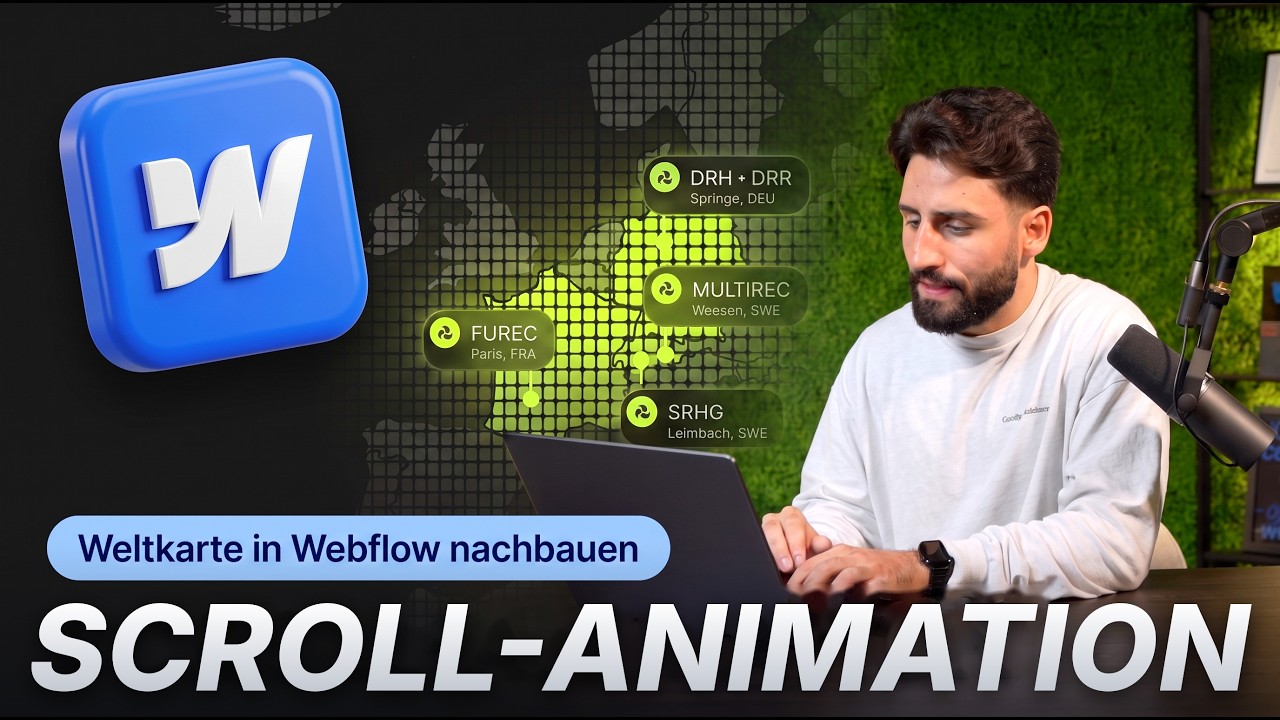
Webwavers is a premium agency for branding, web design and web development with locations in Günzburg and Munich, and one of seven Webflow Premium Partners in Germany. For industrial companies, we build websites where products, applications and proof are structured and findable as text, with clean multilingual setup for export. One example from the sector is DRH: for the internationally active raw materials trader, we delivered rebranding and web design. The brand was meant to convey reliability and precision, carry the company's circular economy idea and bring the sub-brands FUREC, SRHG and DRR together under one roof. We advise neutrally on which platform fits (Webflow, WordPress, TYPO3 or headless). You'll find more on the page GEO and AI Visibility, and the general project process on the page Process.

Frequently Asked Questions
Does cold outreach still work in mechanical engineering?
On a small, targeted scale yes, as mass mailing hardly. There is no dedicated study for mechanical engineering. Across industries, cold email campaigns with 1,000 or more recipients reach only a 2.1% reply rate, small campaigns with up to 50 recipients 5.8% (Hunter). On top of that, 73% of buyers avoid vendors with irrelevant messages (Gartner 2025).
How do buyers in industry search for suppliers today?
Increasingly on their own and digitally. According to Contentful, 84% of decision-makers in manufacturing, industry and tech consider self-service tools critical when choosing a vendor (EMEA, 900+ respondents). Across industries, 45% of buyers used generative AI in their last purchase (Gartner, May 2026). There is no DACH-specific study on supplier research in mechanical engineering.
How long does a B2B buying process take?
About 10 months across industries according to 6sense (2025). We have no dedicated figure for mechanical engineering. During that time, buyers form their ranking: according to 6sense, 94% of buying groups already had it before first contact.
What do industrial buyers expect from a manufacturer website?
Technical data as text, datasheets, certificates, application examples, an inquiry with product reference, pricing logic and a fast path for reorders. The biggest frustrations according to Contentful: lack of price transparency (39%), cumbersome reordering (35%), slow response (24%).
Is a PDF datasheet enough for AI assistants to name my products?
It is better to also offer the most important data as visible text on the product page. Google recommends providing important content as text (Google Search Central). The PDF remains useful as a download.
Do I need a multilingual website to be found internationally?
If you export, yes. Separate URLs per language, clean language markup and translated technical terms help both search engines and AI assistants cite the right version. The details are in the guide Multilingual Company Website.
Should I stop ads and outbound while I build more visibility?
No. Visibility takes months, while ads and outreach deliver faster. Use the cost-per-lead calculator to check how channels compare over 12, 24 and 36 months with your own values.
Conclusion
In industry and mechanical engineering, the supplier decision falls within a long process with technical buyers and a committee. Cold email rarely reaches them at the right moment, and the numbers argue against volume. Buyers research on their own, with datasheets, certificates and increasingly with AI assistants, and they validate the result on your website. Whoever offers technical information as text, proof and a clear inquiry path there gets contacted rather than cold-called. The first step: put three technical supplier questions into an AI tool and see whether you show up.
Support With AI Visibility for Industrial Companies
If you want to know how your product and technical pages perform on vendor questions, get in touch via the contact page. An overview of our work for the sector is on the page Industry & Engineering.
Sources
- Contentful: 2025 B2B Buyer Benchmark Report
- Forrester: The State of Business Buying 2026 (01/21/2026)
- 6sense 2025 B2B Buyer Experience Report, press release (11/12/2025)
- Gartner: 67% of B2B buyers prefer a rep-free buying experience (03/09/2026)
- Gartner: 69% of B2B buyers validate AI insights with sales (05/20/2026)
- Gartner: 61% of B2B buyers prefer a rep-free buying experience (06/25/2025)
- Hunter.io: The State of Cold Email 2025
- Belkins: Cold Email Response Rates (2025)
- Produktion.de: Maschinenbau baut 2024 Beschäftigte ab, VDMA-Jahresbilanz (02/17/2025) (Mechanical engineering cuts jobs in 2024, VDMA annual review)
- Ahrefs: AI Overviews Reduce Clicks (Update, 02/2026)
- Google Search Central: AI features and your website
- Gesetze im Internet: § 7 UWG, Unzumutbare Belästigungen (Unreasonable nuisances)
- Webwavers: DRH Raw Materials Trading project
More guides
All guides
PHP2Shell: Is your TYPO3 or WordPress website affected? What you need to do now
Oct 21, 2026
Read more


Branding Agency, Freelancer or In-House: What Pays Off for Mid-Sized Companies?
Oct 31, 2026
Read more


GEO for B2B Industries: How Expert Content Gets Cited in ChatGPT and Perplexity
Oct 31, 2026
Read more


Wix, Squarespace, Jimdo or Webflow: Which Platform Can Carry a Company Website?
Oct 31, 2026
Read more