SEO & Visibility
Outbound Is Saturated in Aviation and Mobility: How Buyers Find Suppliers and Providers Today


Key takeaways
- The German aerospace industry generated around €62 billion in revenue in 2025, employed 130,000 people and exported 66% of its output (BDLI)
- At ILA Berlin 2026, 765 exhibitors from 37 countries took part and around 110,000 visitors came (ILA)
- Small cold email campaigns reach a 5.8% reply rate, campaigns with 1,000 or more recipients only 2.1% (Hunter), but a small target audience lacks the volume for the second case
- 94% of buying groups had ranked their preferred vendors before first contact (6sense)
- In Germany, advertising by email requires the recipient's prior express consent (§ 7 UWG)
Short answer: In aviation there are only a few relevant buyers and program leads, and almost all of them already know the usual senders. Broad cold outreach therefore delivers especially little here, and by email it is inadmissible in Germany without prior express consent anyway. What works better is being named where buyers build their shortlist: in certificate databases, at trade shows, in search engines and increasingly in AI answers, and then on a website that proves your qualification.
The key points
- The market is big, but the target audience is small: 130,000 employees in aerospace (BDLI 2025), and only a few of them sit in procurement and program management.
- Volume is not an option here. According to Hunter, small campaigns work better than large ones (5.8% versus 2.1%), but a small market only produces small lists anyway.
- Cold emails in Germany require prior express consent (§ 7 UWG). For phone advertising aimed at businesses, presumed consent is enough, but it is tied to concrete circumstances.
- Certificates, references and trade show contacts are checked before any conversation. That check happens on your website and in the answers of AI assistants.
- There is no dedicated study on vendor search with AI in aviation. The general B2B data points in the same direction, though.
This guide goes deeper on the pillar topic Outbound Is Saturated: Why Decision-Makers Find Vendors Through AI Search. The general reply rates and buyer studies are covered there. Here we focus on what is different in aviation and mobility.
Why aviation is a special case for outbound
Outbound lives on reach: the more matching recipients, the more replies. In aviation, that logic breaks down. The market has enormous revenue, but the number of people who actually decide on a supplier, a service provider or a charter booking is manageable. Almost everyone knows each other through trade shows, certifications and projects.
Three characteristics make the difference:
- Small target audience, high order volume. A single order can run for years. In return, the provider is vetted thoroughly before a conversation even takes place.
- International buyers. According to the BDLI, exports account for 66% of the industry's output. If you want to be found as a supplier, you also have to be findable in English, and the decisive person often does not sit in Germany.
- Proof before relationship. Suppliers have to prove that they meet the industry's quality requirements. That happens through certificates, audits and references, not through a clever first message.
Mobility as a neighboring industry adds to this. The VDA reports almost 120,000 lost jobs in the German automotive industry since 2019, currently around 716,000 employees, and a 24% drop in employment at suppliers between August 2019 and August 2025 (VDA, October 2025, via Verkehrsrundschau). Many suppliers are therefore looking for new fields of sale, including aviation. For aviation buyers, that means more providers getting in touch who want to enter the market. This is our own assessment and not a measured statistic, but it matches what the VDA reports about the situation of suppliers.
How big the market really is
The BDLI's industry data for 2025 (published on May 27, 2026) shows a market that is growing, though not equally everywhere.
| Metric | Value 2025 | Source |
|---|---|---|
| Revenue of the aerospace industry | €62 billion (previous year €52 billion, plus 19%) | BDLI industry data 2026 |
| Employees | 130,000 (previous year 120,000) | BDLI |
| Export rate | 66% | BDLI |
| Civil aviation | €45 billion, plus 15% | BDLI |
| Military aviation | €13.5 billion, plus 35% | BDLI |
| Space | €3.5 billion, plus 17% | BDLI |
| Research and development | around €4 billion (previous year €3.6 billion) | BDLI |
What follows for sales is a deduction, not a measurement. A market that grows by a fifth in one year attracts providers. These include suppliers from automotive and industry, but also software companies, agencies and sales service providers that discover this market as a target audience. On the buyer side, however, the teams do not grow at the same pace. The attention available per provider shrinks.
There is no figure for the number of procurement decision-makers in aviation. The BDLI also does not name the number of companies in the industry. For your own planning, a bottom-up list is therefore worth it: Which companies really buy your service, and who decides there?
The math: What outbound delivers in a small target audience
A simple calculation shows why the Hunter numbers from the pillar topic play out differently in aviation. The rates are real values from the study, the scenario is hypothetical.
Hunter gives a reply rate of 5.8% for cold email campaigns with up to 50 recipients, and 2.1% for campaigns with 1,000 or more recipients (Hunter, State of Cold Email 2025, global data, vendor benchmark).
| Scenario (hypothetical) | Recipients | Reply rate according to Hunter | Calculated replies |
|---|---|---|---|
| Targeted campaign to a target list | 50 | 5.8% | about 3 |
| Mid-sized list | 150 | between 5.8% and 2.1% | roughly 3 to 9 |
| Mass campaign | 1,000 | 2.1% | about 21 |
Replies are not yet orders. Rejections and unsubscribe requests are among them. In addition, the math only works out for the mass campaign, and that requires a list of 1,000 matching addresses. A niche with few relevant decision-makers does not have one. The honest conclusion: if you pitch for orders in aviation by cold email, you talk to a few people, and every time you use up a piece of your own reputation.
This fits two findings from buyer research. According to Gartner, 73% of buyers avoid providers who send them irrelevant outreach messages (Gartner, June 2025). And in a small industry, word gets around.
Legal framework: What outbound is allowed to do in Germany
Before we get to alternatives, a point that many outbound plans skip: not everything that is technically possible is allowed. This is not legal advice but an orientation based on the text of the law.
§ 7 of the German Act against Unfair Competition (UWG) regulates unreasonable nuisances. Under paragraph 2, an unreasonable nuisance is always to be assumed
- for advertising by phone call to another market participant, meaning a business, without at least their presumed consent (no. 1),
- for advertising using electronic mail without the addressee's prior express consent (no. 2).
Paragraph 3 regulates exceptions for email advertising to existing customers, with several conditions that must all be met at the same time. In its information sheet (as of March 2022), the IHK Niederrhein points out that an email address on a business card or letterhead does not suffice as consent and that the advertiser must prove consent in case of a dispute. For phone advertising aimed at businesses, presumed consent is only enough if concrete circumstances suggest an objective interest in the call. According to the information sheet, a general industry connection is not enough. The paragraph numbering in the information sheet still comes from the version before the amendment of the law, but the statement remains valid in substance.
On LinkedIn connections, there is a decision by the Düsseldorf Local Court (Amtsgericht Düsseldorf, judgment of November 20, 2025, case no. 23 C 120/25). Two advertising emails to a company's business address were inadmissible without consent, and in the court's view a merely indirect connection on LinkedIn does not establish consent to email advertising (discussed by Datenschutz-Notizen and Scheja & Partners). Check the individual case with your legal counsel.
Other rules apply to recipients abroad. If you do outreach internationally, clarify this with legal counsel before sending.
The legal framework reinforces the point from the numbers section: mass outbound is riskier in Germany than many tool vendors make it sound. The decline in effectiveness therefore has two causes that reinforce each other. Inboxes are full, and the rules are tighter than everyday practice suggests.
How aviation buyers vet providers
There is no dedicated study on vendor search with AI in aviation. The general B2B data is clear, though, and fits the industry's requirements.
According to Gartner, 67% of B2B buyers prefer a buying experience without sales reps (Gartner, March 2026), 45% used generative AI in their last purchase, and 69% still want to validate AI results with vendors (Gartner, May 2026). According to 6sense, 94% of buying groups had ranked their preferred vendors before first contact (6sense Buyer Experience Report 2025). Forrester describes a typical decision with 13 internal participants and 9 external influencers (State of Business Buying 2026). All three studies are cross-industry and not tailored to aviation.
What this looks like in aviation is a working assumption based on the industry structure, not a measurement:
Suppliers, manufacturing and maintenance
Here the vetting starts with proof. With OASIS, the IAQG runs an online database that lists suppliers certified or registered under the rules of the 9100 series of standards. According to the IAQG, it is used mainly by players in the aerospace industry who are involved in selecting and monitoring suppliers (IAQG). The certificate entry is therefore often the first checkpoint. Next comes the question of whether the company shows clearly on its website what it can do: manufacturing processes, materials, test equipment, capacities, references.
Charter, brokers and private aviation
This is a different world with different behavior. Clients expect discretion, fast answers and a high-end presentation. Search here runs more often through recommendations, search engines and direct inquiries. On the market in Germany, the GBAA's report on on-demand air transport (as of the end of 2024) cites 198 airfields served and 2,749 direct connections within Germany (GBAA Insights, January 2026). There are no figures on inquiry channels or booking behavior. Anyone winning clients in this segment mainly needs a clear inquiry path and a brand that radiates trust.
Space, propulsion and deep tech
With highly technical products, the problem is that buyers and partners have to understand complex systems before they get in touch. Here, explanatory skill pays off: clear visuals that show how a system is built and what it does. The HyImpulse project (see below) shows how this can be solved visually.
Mobility beyond aviation
For automotive suppliers that want to broaden their footing, the same pattern applies: buyers check proof before they talk. What is new is the task of appearing credible in a foreign industry. A dedicated page for the target industry with its technical vocabulary works better here than a generic presence.
Trade show, certificate, website: The three channels that work together
In aviation, three channels are closely linked, and outbound is the weakest of them.
The trade show. ILA Berlin 2026 recorded around 110,000 visitors, 765 exhibitors from 37 countries, 330 delegations from around 60 countries and over 400 speakers (ILA Berlin, June 2026). The next ILA takes place from May 17 to 21, 2028. Trade shows are strong precisely because the contact is wanted. What happens afterward is research again: whoever met you at the show looks at your company online, compares you with other exhibitors and may ask an AI assistant for alternatives. That fits the Gartner data but is not specifically documented for aviation.
The certificate. Being listed in directories like OASIS is not marketing, but it is a discoverability channel. If you are certified, you should make that verifiable on your own website too: certificate number, scope, validity, contact person.
The website. This is where trade show contact, certificate and AI answer come together. It is the surface on which buyers decide whether you make the shortlist. More on that in the next section.
Checklist: Is your website ready for international buyers?
| Checkpoint | Why it matters | Typical shortcoming |
|---|---|---|
| Certificate page with number, scope, validity | Proof is checked before the conversation | Just a logo without details |
| Complete English version | 66% export rate of the industry (BDLI), buyers are based abroad | Partial version translated automatically |
| Capabilities per process or service, each on its own page | Assistants point to the page that answers the question | Everything on one service page |
| Technical data, data sheets, materials, test equipment | Technical buyers compare parameters | Marketing copy without numbers |
| References with context (field of use, task, result) | 69% validate AI answers (Gartner) | Client logos without a statement |
| Capacity and response time visible | Buyers plan supply chains | No information |
| Named contacts instead of a shared mailbox | Committees with many participants need the right contact | Contact only via a form |
| Inquiry in a few steps (form, phone, messenger) | Discretion and speed in charter and private aviation | Long mandatory forms |
| Complex technology explained clearly | Decision-makers without technical knowledge on the committee | Only technical jargon |
| FAQ with real buyer questions | Assistants pick up question-answer pairs | Invented questions |
| Visible dates and sources | Verifiability | Texts without a date |
How to implement multilingual content properly is covered in the guide Multilingual Company Website. The basics on discoverability and load time are in PageSpeed and AI Discoverability.
What is realistic in 90 days
This sequence is tailored to a small target audience and complements the four-step plan from the pillar topic.
- Build the target list (weeks 1 to 2). Write down which 40 to 100 companies really fit your service and who decides there. Not from a purchased database, but from trade show contacts, projects and industry directories.
- Bilingual AI test (weeks 2 to 3). Ask 15 questions a buyer would ask, in German and in English, in ChatGPT, Perplexity and Google AI Mode. For example: which suppliers exist for a given process, what to consider when selecting suppliers, who offers charter flights for a certain route. Record who gets named and which pages get cited.
- Make proof visible (weeks 3 to 6). Certificate page, references, data sheets, contacts. Everything a reviewer would otherwise have to request by email belongs on the page.
- Build answer pages (weeks 5 to 10). One page per question or process, with a short answer at the start, numbers with sources and an FAQ. In English too.
- Follow up on trade show contacts (ongoing). Only with consent. Someone who hands over a business card at the booth has not yet consented to email advertising, as the IHK makes clear in its information sheet. Obtain consent explicitly, for example through a form at the booth.
- Measure impact (from week 8). Ask in every inquiry form how someone found you, check referral sources in your analytics reporting and repeat the AI tests every four weeks. The method is described in the post Measure AI Visibility, and Show Up in ChatGPT gives you the starting point.
When outbound in aviation still makes sense
Honesty is part of this. In these cases, personal outreach is still the right tool:
- A very small, well-known target audience. If you know the 30 companies that buy your service, a prepared call or a personal letter beats any visibility strategy. That only holds with real preparation and, for emails, only with consent.
- An existing relationship. Someone who knows you from a trade show, an audit or a project is not a cold contact.
- A new category. If nobody is searching for your solution, no AI can recommend it either.
- Short-term need. If you need inquiries within three months, ads and trade show visits help faster than content.
Conversely, visibility in AI answers is no free ride. The data on the effect on orders is young and comes mostly from the US and from software. For aviation, there is no reliable study.
How we put this into practice
Webwavers is a premium agency for branding, web design and web development with locations in Günzburg and Munich, and one of seven Webflow Premium Partners in Germany. In projects for aviation and mobility, the focus is on clear presentation and a clean inquiry path. Examples from our work:
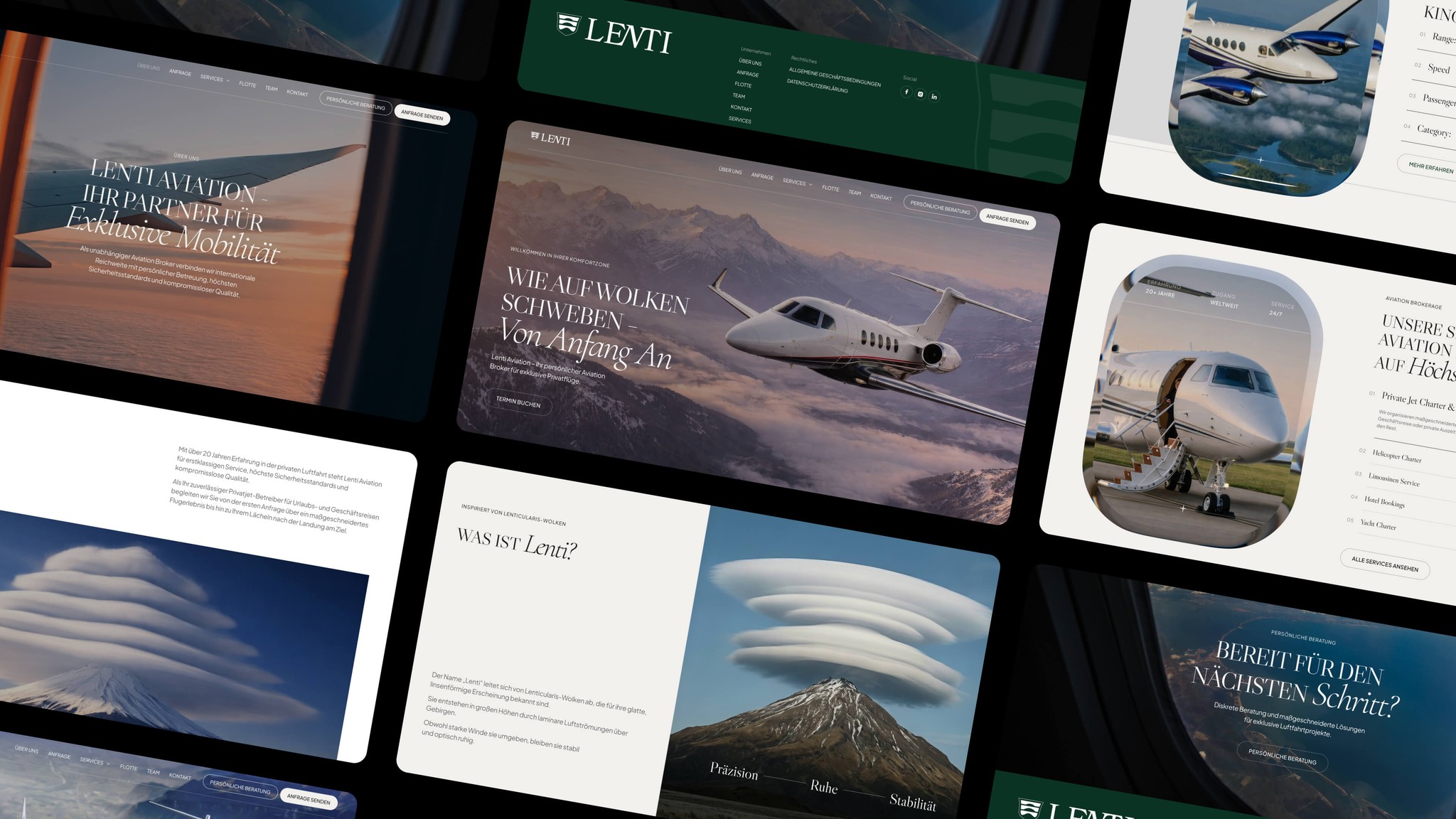
- Lenti Aviation (2025): Corporate identity for a calm, high-end brand world in private aviation, on which the current web design and the Webflow implementation build. More on the project page Lenti Aviation.
- OnlyJets (2026): Web design for private aviation covering brokerage, charter and consulting with a clear inquiry path, built in Webflow. More on the project page OnlyJets.
- HyImpulse (2025): 3D and motion visuals that make rocket and propulsion systems easy to understand. More on the project page HyImpulse.
The flow of a project is described on our page Process: initial call, briefing with 34 strategy questions, strategy session, three moodboards, first three sections of the homepage in Figma, design with a feedback round per milestone, development after final approval in Webflow, Framer or WordPress, then launch and training. We advise neutrally on which platform suits you. More on visibility in AI answers is on the page GEO and AI Visibility, and the industry page is called Aviation.

Frequently asked questions
Does cold outreach still work in aviation?
In very small, well-known target audiences with personal preparation, yes. As mass mailing, no. Hunter measures a 2.1% reply rate for campaigns with 1,000 or more recipients and 5.8% for campaigns with up to 50 recipients. In aviation, the volume for large campaigns is usually missing. On top of that, § 7 UWG requires prior express consent for advertising by email.
Is cold email to aviation buyers allowed?
In principle only with the recipient's prior express consent (§ 7 para. 2 no. 2 UWG). According to the IHK information sheet, a business card or an address on a website does not replace it. For phone advertising aimed at businesses, presumed consent is enough if concrete circumstances suggest an objective interest. Other rules apply to recipients abroad. This does not replace legal advice.
How do buyers find aviation suppliers?
There is no study specifically for aviation. Across industries, buyers research on their own beforehand: 94% of buying groups had ranked their preferred vendors before first contact (6sense). In this industry, certificate databases like the IAQG's OASIS and trade shows like the ILA play a role. After that, buyers check the website and references.
Do aviation decision-makers use ChatGPT to search for suppliers?
Usage is documented only in general terms: 45% of B2B buyers used generative AI in their last purchase, mainly for vendor and product research (Gartner, May 2026). There is no dedicated figure for aviation. The best approach is to test it yourself: ask the same supplier question in German and English and see who gets named.
Do I need an English website?
If you sell or want to deliver internationally, yes. According to the BDLI, the German aerospace industry exports 66% of its output. A complete English version with certificates, data sheets and contacts is therefore part of the basic setup. A half-finished, automatically translated version does more harm than good.
What does the ILA deliver if decision-makers research online anyway?
The ILA creates wanted contact. Research starts afterward, and it happens online. Around 110,000 visitors and 765 exhibitors from 37 countries came together in 2026 (ILA Berlin). Whoever makes an impression there gets checked afterward on the website and in AI answers. Trade show and website therefore belong together.
Should I stop running ads?
No. Ads and trade show visits deliver contacts faster than content. The combination makes sense: ads as a bridge, while you build proof and answer pages in parallel. With the cost-per-lead calculator you can use your own values to check when the build-up pays off.
Conclusion
In aviation and mobility, the target audience is small, international and well informed, and outbound runs into inboxes that are already full. On top of that comes a tight legal framework: cold emails require express consent. Buyers build their shortlist through certificates, trade shows, recommendations, search engines and increasingly AI assistants, and afterward they check on your website whether the proof holds up. Anyone who offers certificates, references, technical depth and a simple inquiry there is more likely to be invited than pitched. The first step is a test: ask the AI in German and English whom it names for your service, and see whether you are among them.
Support with AI visibility
If you want to know how your website performs on supplier and provider questions in AI assistants, get in touch via the contact page. The service page Growth gives an overview.
Sources
- BDLI: Branchendaten 2026, Luft- und Raumfahrtindustrie erreicht neue Rekorde (27.05.2026) (BDLI: Industry data 2026, aerospace industry reaches new records)
- ILA Berlin 2026: Pressemitteilung zu Besuchern, Ausstellern und internationaler Beteiligung (ILA Berlin 2026: press release on visitors, exhibitors and international participation)
- IAQG: OASIS, Online Aerospace Supplier Information System
- GBAA: Insights Bedarfsluftverkehr (Januar 2026) (GBAA: Insights on on-demand air transport, January 2026)
- VDA: Stellenabbau in der Automobilindustrie, Verkehrsrundschau (22.10.2025) (VDA: job cuts in the automotive industry, Verkehrsrundschau, October 22, 2025)
- Hunter.io: The State of Cold Email 2025
- Gartner: 61 % der B2B-Käufer bevorzugen ein Kauferlebnis ohne Vertrieb, Meidung irrelevanter Outreach-Nachrichten (25.06.2025) (Gartner: 61% of B2B buyers prefer a rep-free buying experience, avoidance of irrelevant outreach messages, June 25, 2025)
- Gartner: 67 % der B2B-Käufer bevorzugen ein Kauferlebnis ohne Vertrieb (09.03.2026) (Gartner: 67% of B2B buyers prefer a rep-free buying experience, March 9, 2026)
- Gartner: 69 % der B2B-Käufer validieren KI-Erkenntnisse beim Vertrieb (20.05.2026) (Gartner: 69% of B2B buyers validate AI insights with sales reps, May 20, 2026)
- 6sense 2025 B2B Buyer Experience Report, Pressemitteilung (12.11.2025) (6sense 2025 B2B Buyer Experience Report, press release, November 12, 2025)
- Forrester: The State of Business Buying 2026 (21.01.2026)
- Gesetze im Internet: § 7 UWG, Unzumutbare Belästigungen (Laws on the Internet: § 7 UWG, unreasonable nuisances)
- IHK Niederrhein: Merkblatt Werbung per Telefon, Brief und E-Mail (Stand 03/2022) (IHK Niederrhein: information sheet on advertising by phone, letter and email, as of March 2022)
- Datenschutz-Notizen: Unzulässige E-Mail-Werbung trotz indirektem LinkedIn-Kontakt (AG Düsseldorf, 23 C 120/25) (Datenschutz-Notizen: inadmissible email advertising despite indirect LinkedIn contact)
- Scheja & Partners: Düsseldorf Local Court, LinkedIn Connection Does Not Circumvent the UWG
More guides
All guides
PHP2Shell: Is your TYPO3 or WordPress website affected? What you need to do now
Oct 21, 2026
Read more


Branding Agency, Freelancer or In-House: What Pays Off for Mid-Sized Companies?
Oct 31, 2026
Read more


GEO for B2B Industries: How Expert Content Gets Cited in ChatGPT and Perplexity
Oct 31, 2026
Read more


Wix, Squarespace, Jimdo or Webflow: Which Platform Can Carry a Company Website?
Oct 31, 2026
Read more