Rebranding: when the effort really pays off


Key takeaways
- A rebrand solves positioning problems, not sales problems. This distinction decides its success.
- Five occasions justify the effort, a sixth reason comes up most often and doesn't hold up.
- Between cosmetics and a fresh start lies the refresh, in practice the most common sensible answer.
- The most expensive mistake is not the wrong design, but a switch without a transition phase.
The five valid occasions
The business has changed. The name says print shop, but what is sold is packaging development. If the brand promises something that is no longer true, it works against sales.
The target group has changed. A presence built for trade businesses doesn't work with corporate buyers, and vice versa.
A structural turning point. Merger, acquisition, spin-off, succession. Here a change is not an option but a consequence.
Repositioning on price. If you want to move from the middle of the market into the premium segment, your presence has to come along. A price that is higher than what the appearance promises gets talked down.
Legal necessity. Trademark conflict, naming rights, internationalization with a meaning that doesn't work in a target market.
In all these cases, there is a change in the business that precedes the brand. That is the common feature.
The question before the decision
The business has changed. The name says print shop, but what is sold is packaging development. If the brand promises something that is no longer true, it works against sales.
The target group has changed. A presence built for trade businesses doesn't work with corporate buyers, and vice versa.
A structural turning point. Merger, acquisition, spin-off, succession. Here a change is not an option but a consequence.
Repositioning on price. If you want to move from the middle of the market into the premium segment, your presence has to come along. A price that is higher than what the appearance promises gets talked down.
Legal necessity. Trademark conflict, naming rights, internationalization with a meaning that doesn't work in a target market.
In all these cases, there is a change in the business that precedes the brand. That is the common feature.
The reason that doesn't hold up
The most common trigger for thinking about a rebrand is: sales are stagnating.
That is understandable and usually wrong. Stagnating sales very rarely have a design cause. More often it is a saturated market, a competitor who has become faster, a sales team waiting for referrals or an offer that no longer stands out.
A rebrand solves none of these points. It changes the appearance of a problem, not the problem.
The test question is simple: Are we losing jobs because customers misjudge us, or because they judge us correctly and still decide differently? In the first case, the brand helps. In the second case, working on the offer helps.
A second unsuitable reason: management doesn't like the logo anymore. That is legitimate as a wish, but it is not a business case.
The three levels
Rebranding is not either-or. There are three levels with very different amounts of effort.
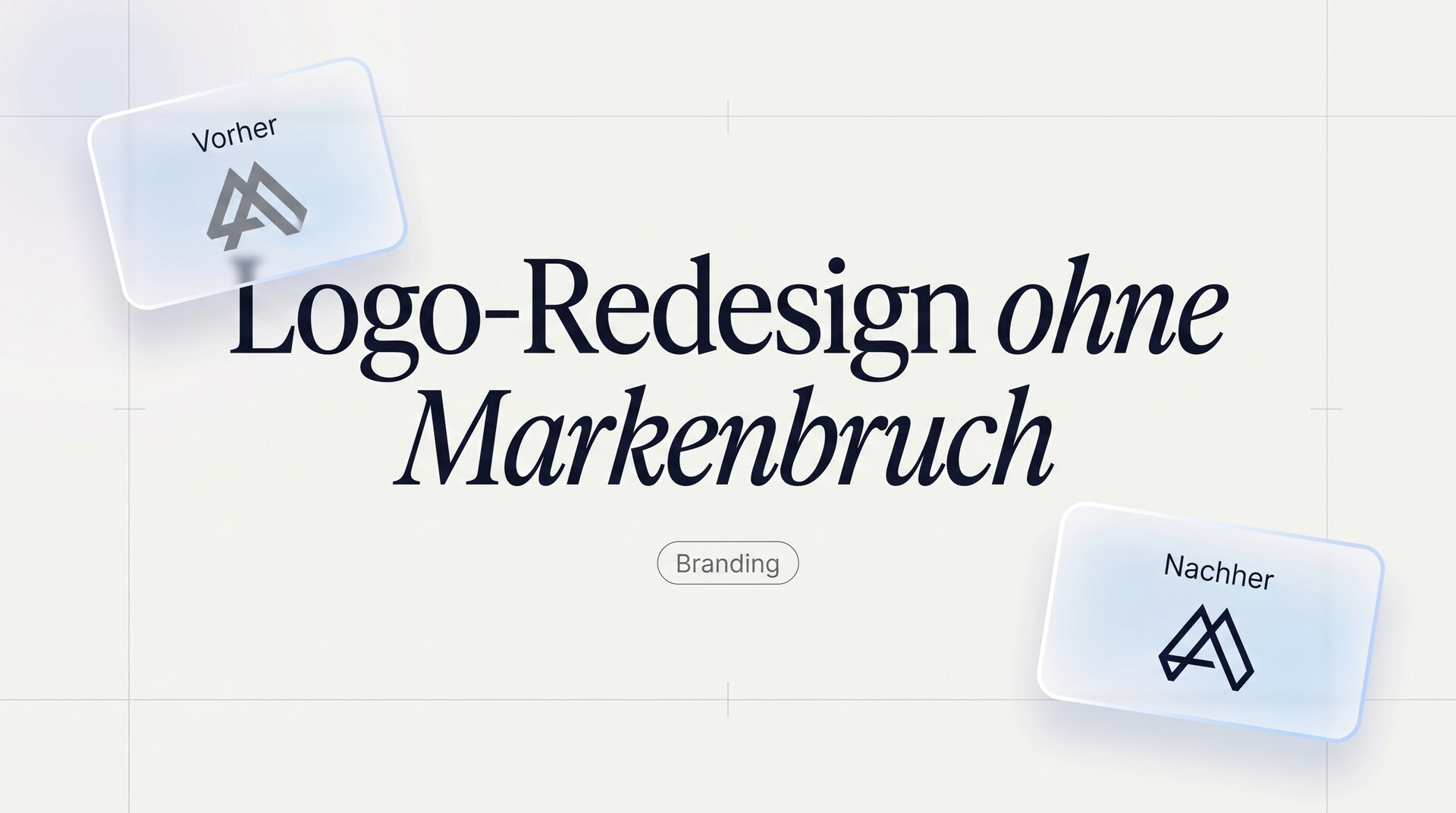
Refresh. The logo keeps its basic form and is technically cleaned up and simplified. Colors are sharpened, the typeface modernized, the applications set up anew. Recognition is fully preserved. Effort: a few weeks, in the mid four-figure to low five-figure range.
Realignment. The visual identity is developed anew, the name stays. This is the most common real change: everything looks different, but nobody has to learn the company's name again.
Fresh start. Name and identity change. This is the most expensive path, not because of the design, but because of everything after it: domain, contracts, signage, search engines, awareness. If you change your name, you give up built-up capital and need a very good reason.
In consulting practice, most cases that start as a fresh start end up as a refresh, because the conversation shows that the actual problem was inconsistency, not the design.
What a rebrand actually involves
The design is the smaller part. The bigger part is the changeover.
Things to consider: the website and all subpages. Stationery. Email signatures. Proposal and invoice templates. Presentations. Vehicles. Signage on the building. Workwear. Trade fair material. Social media profiles. Listings in directories and industry portals. Review profiles. Contracts and terms and conditions, if the name changes.
With a name change, you also need to consider: the commercial register, bank, insurance, domain and email forwarding, as well as search engines. Clean redirects are needed here, otherwise visibility built up over years disappears.
A list of these points before starting is the most important preparation. It shows the real effort, and it prevents the typical situation six months later: new logo on the website, old one on the invoices.
The transition
The most expensive mistake is a cutoff date without preparation. On Monday everything is different, nobody knows why, existing customers are confused.
A three-phase process works better.
Internally first. The team finds out first, understands the reason and can explain it. Employees who are asked by customers about a change they can't explain themselves damage the effect.
On the date, the most important touchpoints. Website, signatures, profiles, signage. This has to happen at the same time, otherwise it looks unplanned.
Then the rest, with a deadline. Printed materials run out, vehicles get new graphics, templates get replaced. Three to six months is realistic.
With a name change, a transitional phrase (“formerly known as the old name”) for about a year is worthwhile. It costs nothing and prevents existing customers from losing touch.
When it is better to wait
Three situations speak against the timing.
The strategy is open. If it isn't clear where the company is heading, you create a brand for a state that won't exist in two years. Direction first, then the image.
A bigger upheaval is coming. Succession, sale, merger. If you complete a rebrand six months before, you pay for it twice.
The budget only covers the design. A new logo without the means to implement it everywhere creates half a year of inconsistency and then a presence that is worse than the old one. If the money isn't enough for the implementation, refreshing what exists is the better decision.
And a fourth point that is rarely said out loud: if nobody in the company really wants the change and it is just considered overdue, the energy for the implementation is missing. Then it becomes a project that never quite gets finished.


More articles