Imagery: why stock photos cost you trust

Key takeaways
- Stock photos aren't bad because they look bad, but because they prove nothing.
- A mediocre real photo has a stronger effect than a perfect bought one.
- Imagery is a set of rules, not a collection. Four criteria are enough.
- One photo day a year covers the needs of most mid-sized companies.
Why stock photos cost you trust
The objection to stock photos is rarely aesthetic. Many of them are technically flawless.
The problem is a different one: they prove nothing. An image of people who don't belong to you, in rooms that aren't yours, doing work you don't do, says exactly nothing about you.
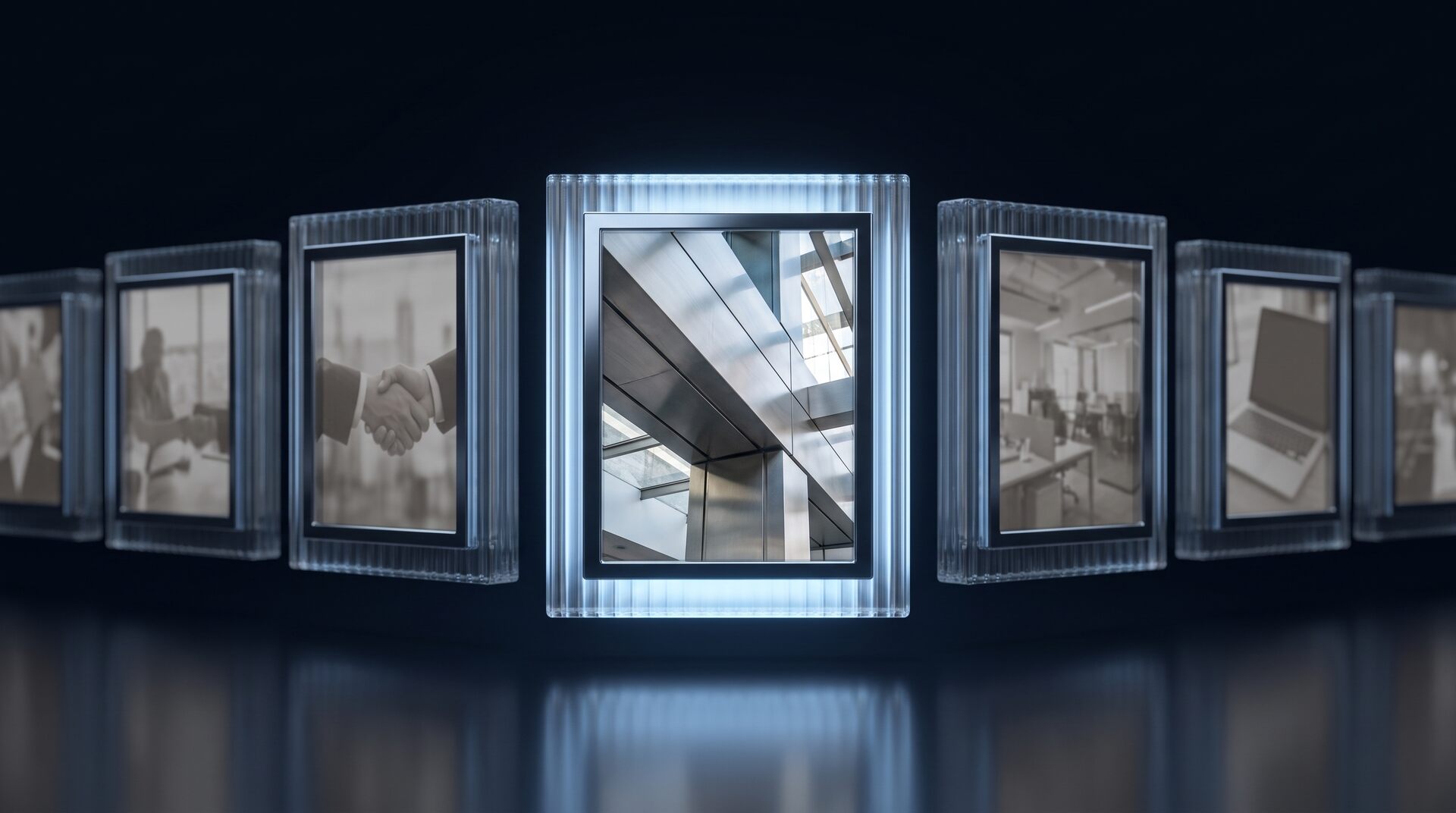
Worse still: visitors recognize it. Not always consciously, but the effect happens anyway. A handshake in a conference room, the team with coffee mugs, the woman with a headset: these motifs are so widespread that they are read as placeholders.
And the conclusion doesn't just affect the image. If one element is recognizably fake, the rest gets questioned too: the case studies, the numbers, the testimonials.
That is the real price: not a bad image, but a doubt that spreads to everything else.
The question before every image
The objection to stock photos is rarely aesthetic. Many of them are technically flawless.
The problem is a different one: they prove nothing. An image of people who don't belong to you, in rooms that aren't yours, doing work you don't do, says exactly nothing about you.
Worse still: visitors recognize it. Not always consciously, but the effect happens anyway. A handshake in a conference room, the team with coffee mugs, the woman with a headset: these motifs are so widespread that they are read as placeholders.
And the conclusion doesn't just affect the image. If one element is recognizably fake, the rest gets questioned too: the case studies, the numbers, the testimonials.
That is the real price: not a bad image, but a doubt that spreads to everything else.
What real photos do that bought ones can't
A real photo does three things at once.
It proves. This is our office, this is our team, this is a machine we worked on. Each of these is verifiable evidence.
It distinguishes. Your rooms don't look like other rooms. Your people don't look like models. That is exactly what makes your presence unmistakable, without anyone having to work on it.
It creates closeness. In B2B, people buy from people. A face that shows up again later in the meeting lowers the barrier before the first contact.
The most common objection is: our rooms aren't nice enough. That is almost never true in the way it is meant. A workshop, a warehouse, a normal office look real, and real beats glossy. What doesn't work are bad photos: blurry, crooked, with neon light. But that is a craft problem, not a room problem.
The four criteria of imagery
Imagery is not a folder full of pictures, but a set of rules by which new images are selected or produced. Four criteria are enough.
1. Subject matter. What is shown? People at work, results, details, rooms, abstract motifs. Define two to three categories and leave out the rest.
2. Perspective and distance. Close or wide, at eye level or from above, posed or observed. This is the factor that holds images together most strongly.
3. Light and color. Warm or cool, bright or high-contrast, saturated or restrained. Consistent post-processing brings even different shots into line.
4. What doesn't appear. The most important point and the one that is always missing. No staged handshakes, no people smiling into the camera, no empty conference rooms.
Two pages with example images and these four points are enough for everyone on the team to choose suitable images.
The photo day that covers a year's needs
For most mid-sized companies, one photo day a year is enough. What comes out of it supports the website, proposals, presentations, social media and job postings.
What belongs on the shot list:
Individual portraits of everyone with external contact, in the same light and the same setting. This is the most important item, because portraits are needed most often and go out of date fastest.
Work situations without staging: people actually working, not pretending to.
Details: tools, materials, screens, hands.
Rooms without people, for backgrounds and transitions.
Three to five motifs in portrait and landscape format with room for text.
Costs: half a day to a full day with a photographer costs 800 to 2,500 euros, depending on region and experience. Pay attention to the usage rights: unlimited in time, all media, with the right to edit. That belongs in the contract, not in a later conversation.
When stock material is still fine
A blanket ban would be impractical. There are cases where purchased material is acceptable.
Abstract and technical motifs. Textures, materials, backgrounds, aerial shots. There, authenticity is not a criterion because nothing is claimed about you.
Illustrations and graphics. They don't pretend to be reality.
Articles and blog images. When it is clear that the image illustrates a topic and makes no statement about you.
Stock material is not acceptable anywhere it would be read as your reality: team, rooms, clients, projects, work situations.
A simple rule: if a visitor could think the image is yours and it isn't, it doesn't belong on the site.
And a note that is becoming more important: the same applies to AI-generated images. Unproblematic as an abstract background, but as a supposed team photo, a breach of trust that gets exposed, because images like that are now recognizable.
What images need to deliver technically
The most beautiful image library is of little use if it slows the site down. Four technical points.
Format. WebP instead of JPEG or PNG. Typically saves 30 to 50 percent at the same quality.
Size. Deliver images at the resolution they are displayed at. An image that appears 600 pixels wide doesn't need to be loaded at 3,000 pixels wide. This is the most common cause of slow pages.
Dimensions in the code. Specify width and height so nothing jumps while loading. Costs one line and directly improves one of the Core Web Vitals.
Alt texts. One sentence describing what can be seen. Mandatory for accessibility, helpful for image search. Not image1.jpg, but Two employees inspecting a component in production.
Plus: light and dark variants if your site has a dark mode. An image with a white background stands out unpleasantly there.


More articles