On-page SEO: the elements that really count

Key takeaways
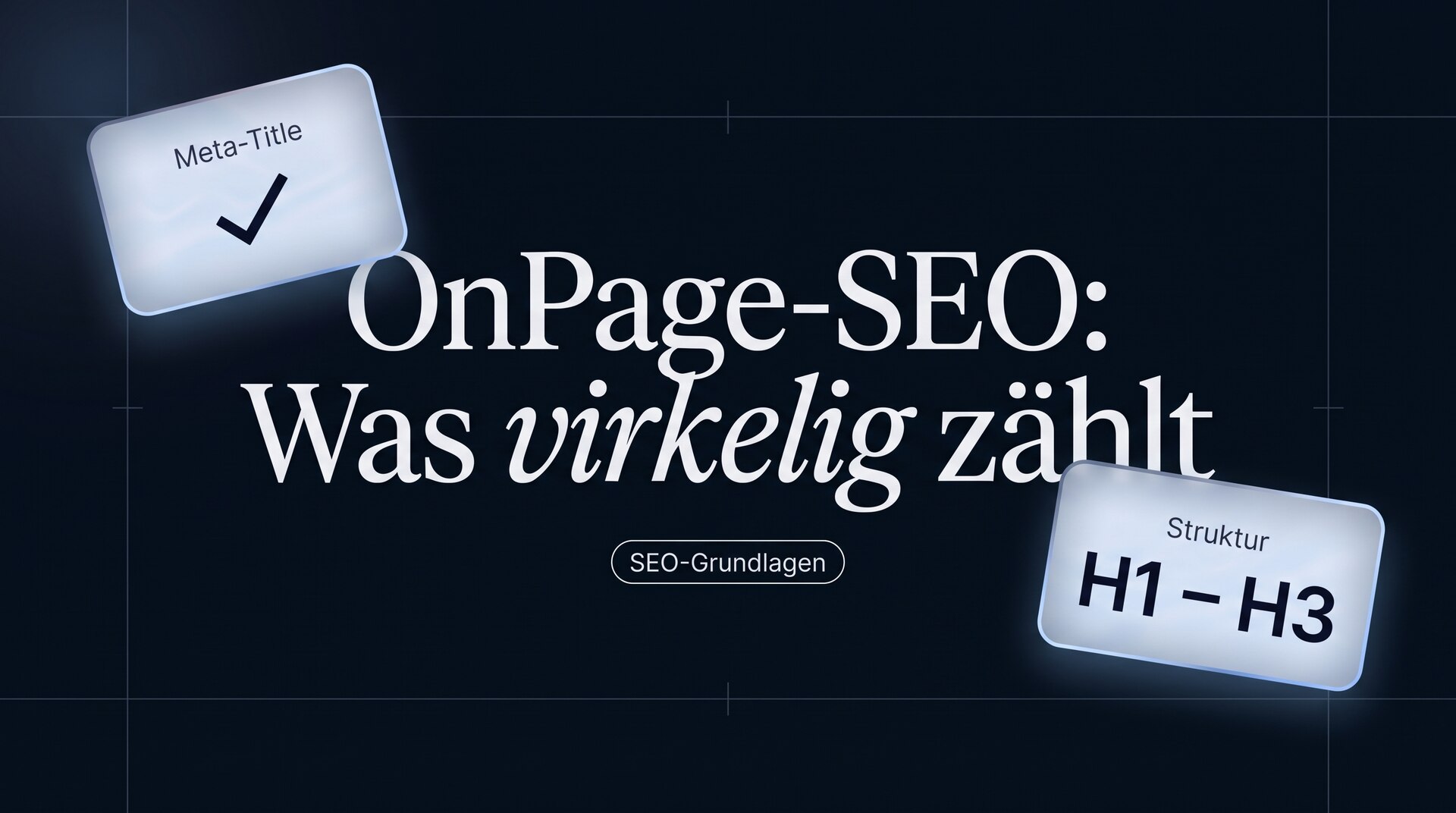
- Five of around twenty on-page factors account for most of the effect. The rest is maintenance.
- The title is the only lever you can change in hours and measure in days.
- Internal linking is the most underestimated lever, because it is completely in your own hands.
- Keyword density hasn't been a factor for years, topic coverage on the other hand is.
What on-page SEO is and what it isn't
On-page SEO covers everything that happens on your own website: content, structure, technology, linking. It is distinct from off-page SEO, meaning everything that happens outside, above all links from other websites.
The difference matters in practice: on-page is completely under your control. You don't need to convince anyone, no cooperation, no budget for links. What you change today is online tomorrow.
That is exactly why it pays to get on-page right first. Building links while your own pages are unstructured is like pouring into a leaky barrel.
Factor 1: The title
The title is the headline that appears in the search results. It is both a ranking factor and the text that decides whether someone clicks.
Three rules: under 60 characters so it doesn't get cut off. The most important word at the front, because the front carries more weight and because people read from the left. And a unique title per page, because two pages with the same title compete against each other.
The most common mistake in companies is an automatically generated title following the pattern "Page name – Company name". That gives away the most valuable spot on the whole page to a term nobody searches for unless they already know you.
The order if you only have one day
On-page SEO covers everything that happens on your own website: content, structure, technology, linking. It is distinct from off-page SEO, meaning everything that happens outside, above all links from other websites.
The difference matters in practice: on-page is completely under your control. You don't need to convince anyone, no cooperation, no budget for links. What you change today is online tomorrow.
That is exactly why it pays to get on-page right first. Building links while your own pages are unstructured is like pouring into a leaky barrel.
Factor 1: The title
The title is the headline that appears in the search results. It is both a ranking factor and the text that decides whether someone clicks.
Three rules: under 60 characters so it doesn't get cut off. The most important word at the front, because the front carries more weight and because people read from the left. And a unique title per page, because two pages with the same title compete against each other.
The most common mistake in companies is an automatically generated title following the pattern "Page name – Company name". That gives away the most valuable spot on the whole page to a term nobody searches for unless they already know you.
Factor 2: An H1 that matches the search term
Every page needs exactly one H1. It tells search engines and readers what this page is about. It doesn't have to be identical to the title: the title appears in the search result, the H1 on the page.
Below it, H2 and H3 structure the content. This hierarchy is not a formality: it is how search engines recognize which subtopics a page covers. And it is how readers decide whether to keep reading.
A common mistake is choosing headings by appearance instead of meaning, so using H3 because H2 looks too big. Size belongs in the styling, not in the markup.
Factor 3: Content that answers the question completely
The days when text length and keyword density were counted are over. What counts is completeness: Does the page answer the question someone came with, and the follow-up questions too?
A practical test: search for your target term and look at the first five results. Which subtopics appear in all of them? That is the minimum scope. What is missing from all of them? That is your opportunity.
The length follows from that, not the other way around. Some questions are answered in 400 words, others need 2,500. Artificially padding a page helps nobody and is now more likely to hurt.
Factor 4: Internal linking
The most underestimated lever. Internal links do three things at once: they guide readers onward, they show search engines which pages belong together, and they pass authority from strong pages to weaker ones.
Three rules, that is all it takes: the anchor text describes the destination, so "how a relaunch works", not "click here". Every important page gets at least three incoming links from body text. And pages on the same topic link to each other instead of standing next to each other in isolation.
The nice thing about it: it costs nothing but attention while writing.
Factor 5: Load time and mobile usability
Technology is not a ranking factor of its own in the narrow sense, but it decides whether the other four have any effect at all. A page that takes four seconds on a phone loses visitors before the content is read.
The three most common causes are always the same: images that are too large, scripts that block rendering and fonts loaded from external servers. All three can be fixed without a rebuild.
PageSpeed Insights shows you where you stand in two minutes. What matters is the mobile score, not the desktop one.
What you can safely ignore
To make the list complete, here are the points that appear in many checklists and hardly move anything today:
Keyword density. No longer a factor, and trying to hit it makes copy worse. Meta keywords. Ignored for more than fifteen years. Exact word repetition. Search engines understand synonyms and context. Text length for its own sake. See above.
If you drop these four and take the five above seriously, you are further ahead than most competitors.


More articles